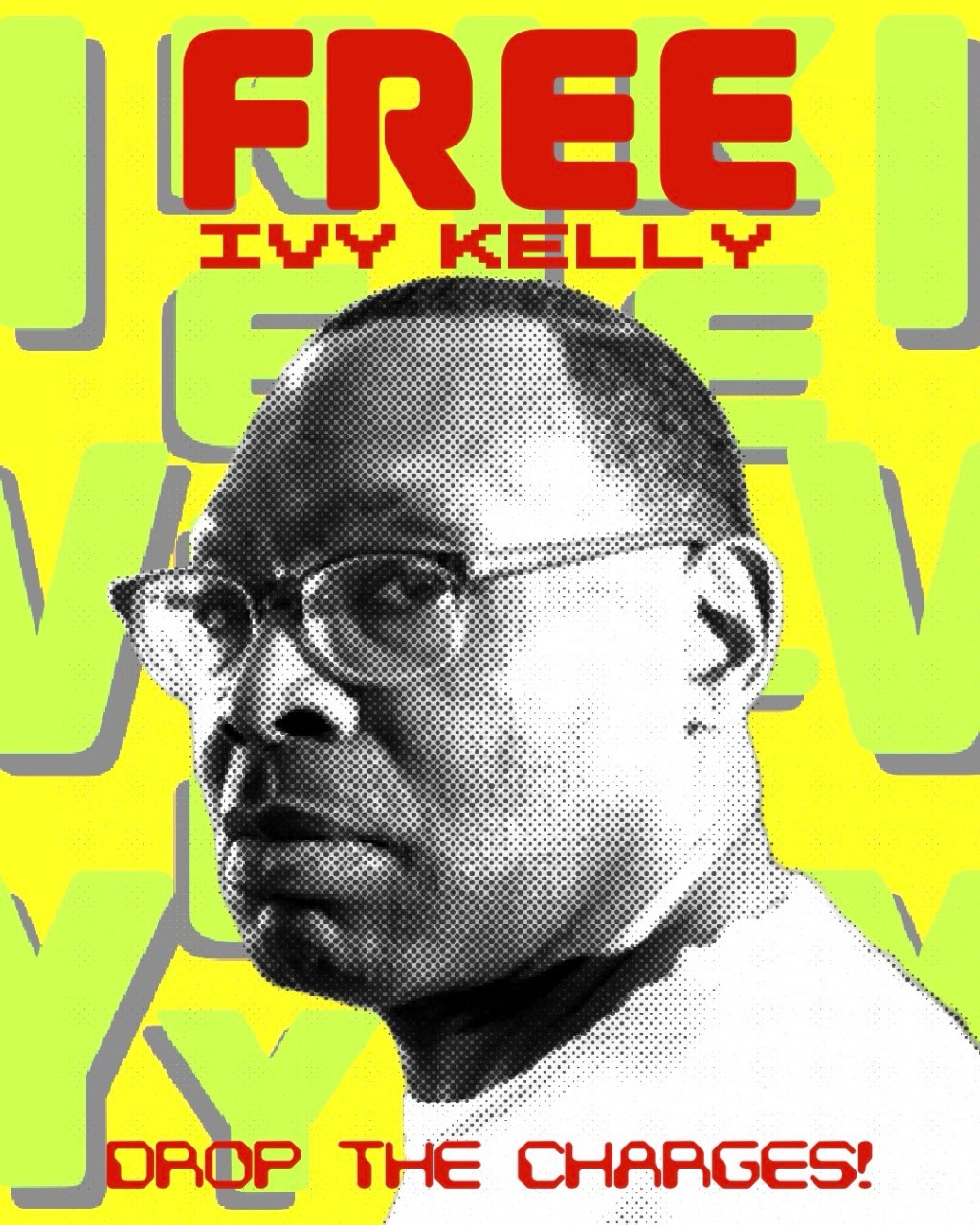
For almost 30 years, Ivy Kelly has been trapped inside the mass incarceration machine for a crime he didn’t commit. Pinned for the murder of his friend, Ivy has spent the majority of his adult life captive behind bars, fighting for his innocence. Even after decades inside prison, and eventually having his guilty verdict thrown out, the system has continued to keep Ivy in chains. He’s now going to trial on November 2nd after the state’s attorney has refused to drop the charges against him, despite his conviction being overturned.
In 1999, Ivy was arrested and charged for the killing of his best friend, Ward. Arrested for the crime by two corrupt Robbins PD detectives (who were under investigation by the FBI during the time of the killing), Kelly went to trial where he had to face corrupt judge Paul Nealis, a former prosecutor who was working for the state at the same time notorious CPD detective Jon Burge was torturing confessions out of young Black men in Chicago. Coupled with an ineffective counsel, Ivy was found guilty of first degree murder at the age of 25.
Ivy has always maintained his innocence.
From prison, he became a jailhouse lawyer, learning the law, and how to file petitions to continue to challenge his conviction. In 2014, his efforts paid off, and forced a ruling which required a Cook County Judge to hold an additional hearing to decide on a retrial. Proceedings were delayed another 8 years, but by 2022 the state approached Ivy with a deal: In order to avoid a new trial, they’d reduce his sentence which would allow him to walk free that day, on the condition that he plead guilty for the 1999 shooting. Ivy courageously refused and proceeded to prepare for the retrial. In 2023, a Cook County judge threw out his 1999 conviction. In a move to save face for the state, the judge ruled Ivy’s conviction overturned on the basis of ineffective counsel, instead of Ivy’s original petition to have his case thrown out due to the fact that the state’s prosecutors had withheld key evidence during his trial that could have exonerated him from the get go.
However, despite his conviction being overturned, both then State’s Attorneys Kim Foxx and the current Eileen Burke have continued to punish Ivy by relentlessly pursuing murder charges against him. Both the progressive prosecutor Foxx and reactionary Burke made it their mission to keep Kelly behind bars while they prepared for retrial, claiming he was a “safety menace”, resulting in his current detention inside the hell on earth at Cook County Jail where he’s being held today. Ivy Kelly is living the American Nightmare.
Ivy’s continued fight for his innocence is a fight against the system. If he were to win, not only would it expose the state’s corruption (from the police to the prosecutor) that led to his imprisonment, but it would expose the illegitimacy of the system as a whole. With Illinois having the highest rate of wrongful convictions in the country, Ivy is just one of many caught up in the mass incarceration machine. However, instead of being deterred and demoralized, Kelly stands defiant. Foxx, Burke, and the entire injustice system can not handle the fact that Kelly has never shied away from his claims to innocence and fought to clear his name. The system seeks to make an example out of him: challenge our authority by fighting for your freedom, and face the brutal consequences.
Since Ivy has refused their offer and maintains his innocence, vindictive prosecutors are forcing him to prepare for trial inside Cook County Jail rather than fight from outside. This is a strategy the prosecutors use to avoid losing their cases: detain the accused pretrial, where they are subjected to deplorable conditions that make it more likely they’ll take a plea deal. The strategy of breaking the will of the accused down until they plea is possible because of one policy: Illinois’s 2023 SAFE-T Act. A law which got rid of cash bond in the state of Illinois and deferred pretrial detention to a judge’s decision. Since her election in 2024, Burke has been using this seemingly more equitable reform to the state’s advantage by arguing for pretrial detention in front of the judge at every opportunity. This strategy seems to be working, with a recent study from the Illinois Network for Pretrial Justice showing that when prosecutors petition to detain the accused pretrial, the judge agreed in 74% of cases1. Kelly is one of thousands who’s background was used against him in order to keep him behind bars, despite his conviction being thrown out.
The state is trying to make an example of Ivy and sending warning shots to others falsely accused: don’t cooperate and we’ll come after you with everything we got.
In addition to the punitive nature of the state’s attorney’s office and the negative consequences of the SAFE-T Act, Ivy’s case further exposes the police as the on-the-ground stormtroopers of the government who make this all possible. Court documents accuse Kelly’s arresting officers of coercing an eye witness to point the finger at Kelly, a crucial component in the state’s case. This comes as no surprise, with police around the country using everything from intimidation to torture in order to secure an easy conviction. In Chicago alone, there’s been at least 50 wrongful convictions linked to just a single police detective, Reynoldo Guevara, known for torturing victims and witnesses into confession or testimony. In one of those cases recently overturned, Tyrece Williams (accused of murder similarly to Ivy), a witness later came forward to claim that Officer Guevara and other officers on the case used beatings and threats of false allegations for imprisonment in order to coerce him into testifying against Tyrece.
Even in these cases, Burke has made it her mission to continue to punish exonerated victims of police torture, by refusing to review their petitions for claims of innocence, meaning their overturned cases remain on their background. This continues to block access to housing, jobs, and other resources for mere survival.
Recognizing these claims of innocence would admit wrongdoing on the part of the state, for the decades stolen from men and women behind bars. By allowing Kelly to walk free, the state would have to admit to its 30 years of wrongdoing. As Burke doubles down, Kelly remains unshaken.
Ivy Kelly writes:
“Wrongful convictions don’t just hurt those wrongfully convicted. It hurts the victims families who in the end never truly get justice. It erodes the public’s trust in the judicial system as a whole and it costs the taxpayers. When a system that purports to be about justice leads the nation in wrongfully convicting it’s most vulnerable constituency, i.e. Blacks, Hispanics and poor Whites we have to at the very least investigate or review how it keeps happening.”
The longstanding pattern of wrongful convictions is not an accident, it is the system working as intended. As we approach the halfway mark of Black August, we are reminded of George Jackson who spent 11 years in prison for an alleged $70 robbery before he was killed by guards for refusing to bow to the system. As Keshia Golden’s trial draws near at the end of August, we prepare to support her as she is prosecuted by the state for defending her and her unborn baby against her abuser. Ivy, George, and Keshia’s cases all represent the contradiction that is at the core of this system. The courts are portrayed as being places where justice is achieved, but in reality, they function as tools of oppression. When the system threw the book at Ivy, Keshia, and George, they all bravely rejected the notion that they must lie down and submit to the injustice thrust upon them. Where the system’s repressive and coercive methods try to instill fear in the masses, people like Ivy inspire us to fight back. Ivy is being punished for his defiance against the system and needs our support. Join us as we spread his story far and wide, and build a movement in the streets that refuses to be afraid of this system any longer.

