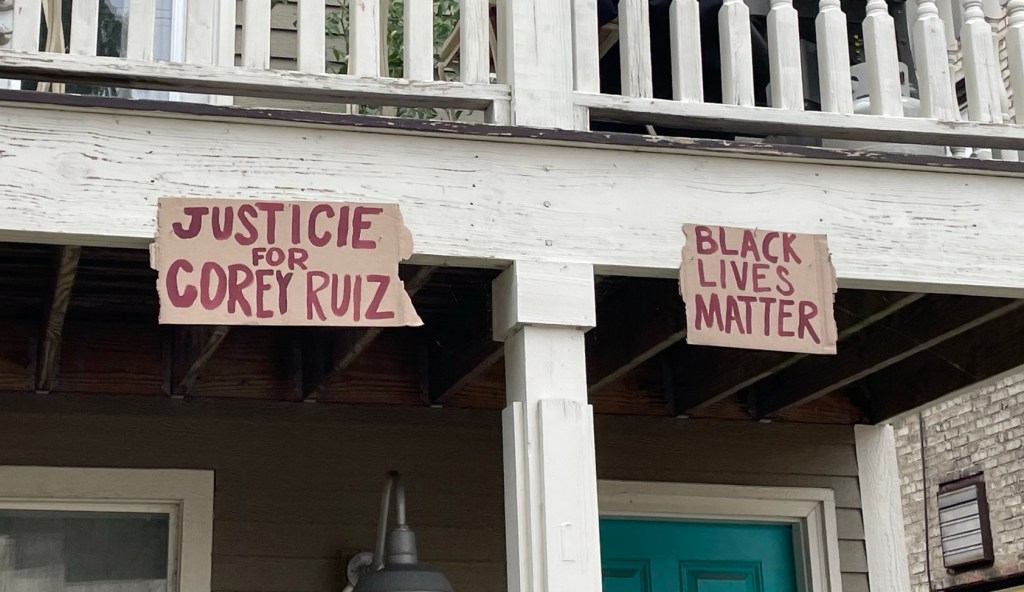
On July 25th, a group of Dare to Struggle members went up to Madison, Wisconsin, to understand the mood on the ground following the execution of 38-year-old Corey Ruiz by veteran police officer Kiel Peterson.
We first stopped at the site of Corey’s murder which is now reminiscent of 2020’s George Floyd Square in Minneapolis. Supporters had erected barricades blocking off the street, laid hundreds of flowers in the intersection in honor of Corey, and declared the area a “No Kill Zone.”
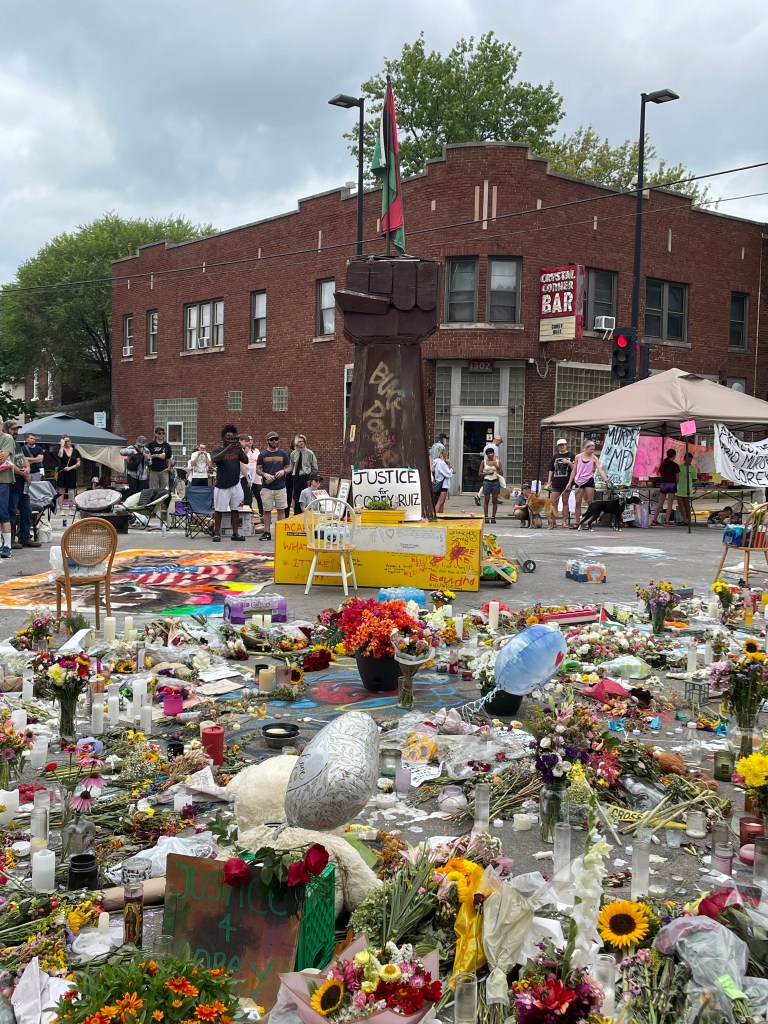
Well-supplied mutual aid tables extended in all directions of the four corner intersection. A contingent from Minneapolis had donated the famous fist sculpture that was erected at the site of George Floyd´s murder, now placed in the middle of the street. No police were in sight.
Some people were mourning at the scene of Corey’s execution alongside Corey’s family who had gathered at the site to lay flowers. Despite the solemn mood of the family and a few supporters with them, the atmosphere surrounding them was completely absurd: on one end of the street, a group of people gathered to do yoga; on the other, a cookout was happening, with arts and crafts projects being led nearby. Within 5 minutes of our crew being there, someone got on the megaphone to announce a community garden would be assembled later that day on the north side of the square. Hundreds of people seemed content just to be there, chilling at the site of Corey’s execution.
The question in our minds was, where is the anger? The rage? Bystander footage showed the gruesome last moments of Corey’s life: hunted by 4 police officers as he fled on his bike, surrounded, tased and tackled, before being shot three times in the head like an animal in the street. The righteous anger that unfolded in the streets in 2020, after bystander footage showed the gruesome last moments of George Floyd’s life, awoke a sleeping giant: the masses in Minneapolis took action, burned down a fucking police precinct, and inspired millions of others around the country to step forward. The militancy and bravery of the masses in 2020 forced the state to convict Derek Chauvin for killing George Floyd and gave us a lesson in how to achieve the demand of jailing killer cops.
What Do the Masses Have To Say?
We spoke to a handful of Black residents who shared frustration at what was going on around us at the site of Corey’s murder. In their own way, they described feeling contained. People spoke to us about what happened in Madison in 2015 following the murder of 19-year-old Tony Robinson. Tony was murdered just two blocks from where Corey was shot, and his killer, Madison police officer Matt Kenny, remains on the force today. A resident showed us a picture of a burning MPD squad car to demonstrate the difference between how Madison responded after Tony‘s murder in 2015 and what has unfolded this past weekend. People understood the necessity of reigniting the militancy of 2015 and 2020, and that these moments were steps in the right direction. People taking risks, making sacrifices, confronting the pigs, destroying their infrastructure, and taking over blocks and buildings -– history shows us that these are the bare minimum requirements for the movement against police brutality to achieve any kind of success.
With the recent history of rebellion on the minds of many in Madison, the atmosphere of controlled peace at the site of Corey’s execution discouraged any expression or action of righteous anger. When someone would hop on the mic at the square and speak their the rage, many in the crowd listening would clap, whoop, holler in support, then immediately go back to painting their wooden planter boxes or hitting the downward dog pose fifteen feet from where Corey was murdered. Much of the activity we saw in Madison brought to mind some of the most frustrating moments of 2020, when the rebellion was being misdirected into dead-end mutual aid, identity politics, and an emphasis on building “community” as a substitute for taking the fight directly to the cops’ front door. The effect of all this on the gathering in Madison was to lay down an unspoken rule: any anger, anything confrontational, and anyone who attempted to honestly address this community’s longstanding divisions was not welcome at the memorial site.
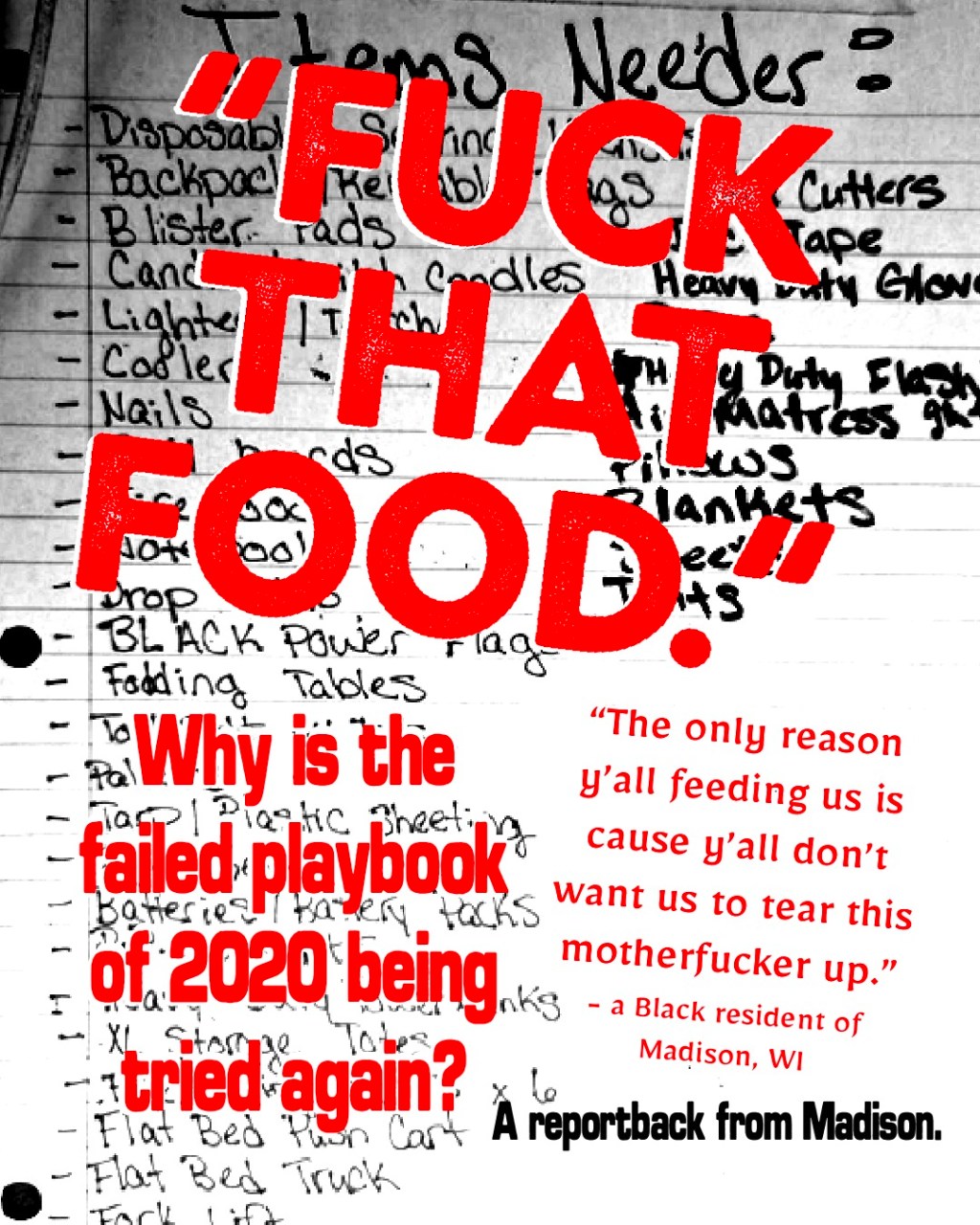
As one frustrated Black resident named Wayne put it, “While y’all running around here, tryna feed us… FUCK THAT FOOD! The only reason y’all feeding us is cause y’all don’t want us to tear this motherfucker up! Y’all think we slow, get the fuck on with that shit.”
Wayne described mutual aid as another attempt to put a lid on people’s justified anger against the cops and the system, and a great summation of the situation in Madison as a whole.
Our crew went out to talk with more people to get a deeper sense of what the masses were thinking about everything thats going on. The Black Madisonians we spoke to viewed Corey’s murder as another slap in the face, labeling Madison one of the worst places in America for a Black person to live. Despite being known as a “progressive, liberal utopia,” in the middle of red Wisconsin, Black residents described color-blind racism matched by limited job opportunities, poor housing and education, and an erosion of their civil rights. Study after study puts numbers behind what these residents laid down to us.
For example, a 2023 report on racial disparities in Dane County (where Madison is located) found the median household income for Black residents to be $37,815 compared to $80,063 for white residents; Black residents were 3x more likely to lack health insurance than white residents, and only 6.4% of Black eighth graders were proficient in math compared to 46.9% of white eighth graders. Another Madison local named Derek pointed out that, in light of these disparities, it is easy to buy people’s silence when tensions run high. According to him, the city and local non-profits use jobs, contracts, and political clout to pacify Madison’s Black community leaders in the wake of rebellion like in 2015 after Tony Robinson was murdered. These residents are right to point out just how similar the city’s strategy to de-mobilize community leaders was to the way local organizers were using mutual aid to contain attendees’ anger.
The Organizers
That evening, there was a planned vigil. The organizers of the vigil included the Party for Socialism and Liberation (PSL), Freedom Road Socialist Organization (FRSO), a Worker’s World Party front called Wisconsin Bail out the People Movement (WiBPM), and Freedom INC, to name a few. These organizations had led the larger marches for Corey in the days prior, resembling parades more then they did protests: leading crowds of people to walk around aimlessly for hours, reusing high school sports chants like “I believe that we will win”, and keeping law and order through their own peace police in hi-vis yellow vests. The police had adopted the tactic of clearing out of town in the wake of Corey’s murder and have been almost completely absent from these protests. Perhaps they have some confidence in the organizations doing the police work for them or understand how a heavy handed approach could lead to escalations reminiscent of 2015 or 2020.
During the vigil, one PSL organizer acknowledged the 2020 rebellions and the need for militancy in combatting police brutality, only to conclude by telling the crowd to join a “Glo March” where protesters donned glow stick necklaces and bracelets while they marched toward the capital, where organizers would periodically remind the crowd to “keep it peaceful” and “we keep us safe.” Insisting that protesters remain peaceful after Corey’s cold blooded murder is another slap to the people under the gun of police brutality and the advanced sentiment Black Madisonians are expressing. It fails to see Corey’s life as one of the more than 8,000 lives stolen by police since 2020, ignoring the reality that this system is at war with Black and other oppressed people.
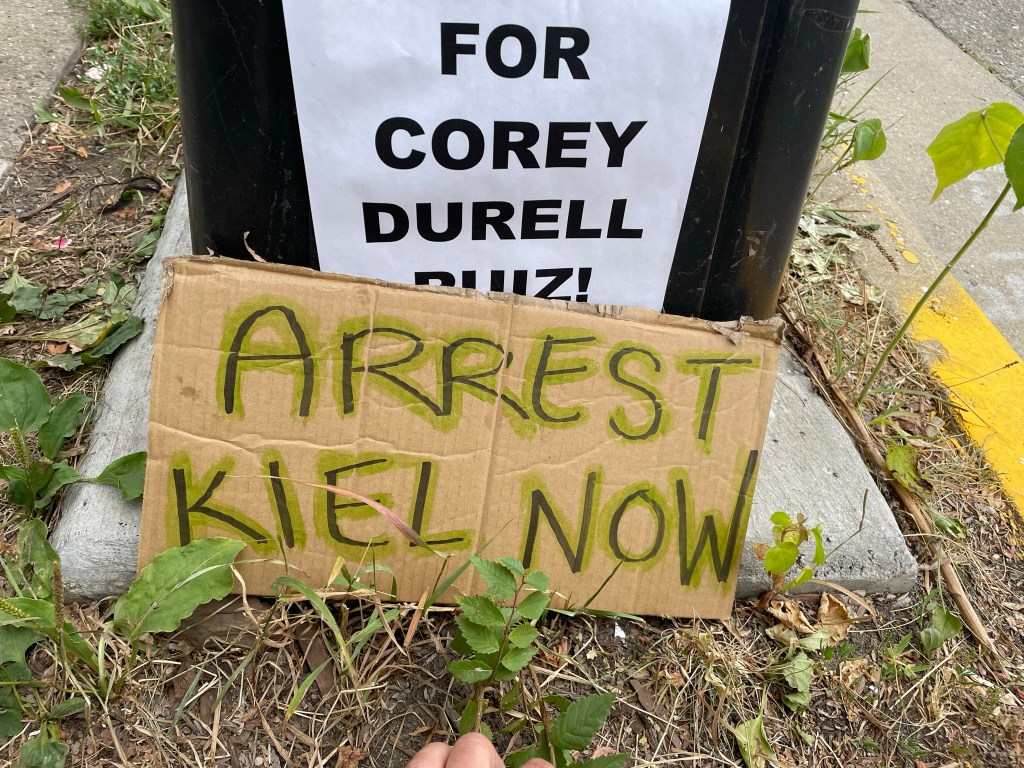
Veiled under the calls to arrest Kiel were PSL and FRSO’s demands for “community control over the police,” a toothless plan to “strengthen” Madison’s civilian oversight board and inspector. Yet, neither this oversight board nor the inspector have the authority to arrest Kiel, let alone prosecute him for Corey’s murder. We have seen this exact scheme play out in Chicago. Call for a system-approved community control of the police and other demands are tacked on as secondary to the main demand raised by the masses: that killer cops should be jailed. But as these organizations stifle the energy of the movement, they begin to raise these secondary demands as primary, ignoring the fact that killer cops remain free. What happens in the end is the people get another oversight board with no real power, co-sponsored by the supposedly radical organizations, now spun as community control. In Chicago where this scheme has manifested in things like the Community Commission for Public Safety and Accountability (championed by FRSO), they have done nothing to hold killer cops accountable.
Instead of principally standing with Corey’s family while struggling with them about their calls for peace, to call them to question whether glow sticks and dancing will bring real justice for Corey, the organizers are using the family’s calls for peace to push their toothless “community control” agenda, sidelining the skeptics and rebels that see the need for more. These organizations have a long history of steering movements away from militancy and into passive reformism and we are seeing it play out again in Madison.
Why are they doing this? These organizers actually have a lot to lose if the resistance they seek to lead took a militant direction, and a lot to gain if it doesn’t. In Chicago we have seen so-called activists make careers off the path of least resistance, using their protester credentials to receive appointments at city hall and cushy non-profit jobs. Time and time again, PSL and FRSO have taken this path; working with police and city officials to plan protests, re-directing people’s energy into bullshit elections and ballot measures, and promoting the false idea that we will win our freedom if we respect the rules laid down by our oppressors.
The “parade around town” tactic from activists is a perfect compliment to the “hands-off” strategy being deployed by progressive mayors across the country in the years since the George Floyd rebellion. Madison Mayor, Satya Rhodes-Conway, is able to protect her reputation as a progressive while effectively containing popular anger by keeping the pigs away from the protestors. Conflict, confrontation, or property destruction are kept to an absolute minimum, and Madisonians will be allowed to have their intersection for a week or two and burn themselves out. Groups like PSL ensure that no one takes advantage of the police’s absence, helping to shield the killer pigs and the mayor at the same time.
The evening ended with a march of hundreds of people led away from the police precinct and government buildings and into Madison’s busy nightlife district filled with bars. Protesters were instructed to sit down, occupy the street, and attempt to close down businesses. Police never bothered to show up and the sit in eventually turned into somewhat of a party itself, filled with dancing, glow sticks, and PSL banging drums to keep the party vibes going. Fuck that.
Throw Away the 2020 Playbook
The mutual aid fixation, the parade-like marches, the obsession with safety, and opportunistic leadership on display in Madison represent a larger problem in the struggle to rebuild the movement against police brutality in this country. When police killings spark a spontaneous reaction from the masses, the 2020 playbook (the strategies adopted after the masses rebelled in the wake of George Floyd’s murder) gets thrown on the table by leftists, treating it as the only way to respond and as a science. The parades, community gardens, and mutual aid tents are lauded as the logical response when in reality are a desperate attempt to paper-over deep divides and rage among the masses in a grieving city. As we write this, there are more militant actions being proposed only to get demonized and cancelled online by leftists for not meeting the purity test of safety standards they’ve cooked up in their heads.
Many people correctly point out that nothing changed after 2020. While it was the people’s righteous rebellion in the early days of the George Floyd Uprising (and the threat to do it again later if the system didn’t meet their demands) that got a killer pig convicted, it was the non-profits, lawyers, and groups like BLM, PSL, and FRSO that derailed, co-opted, and contained the anger of the masses against police killings to benefit themselves.
Had that anger been sustained and organized into repeated confrontations with the system, had it been attentive to the mass sentiment like we heard from the masses of Madison, the stakes would be higher for pigs with murder on their minds: when the police know that murdering one of our own means rage being unleashed on their streets, they’ll think twice about murdering babies, teenagers, and adults alike.
The 2020 playbook needs to be thrown in the trash. The movement against police brutality must adopt a new strategy and set of tactics if we want to achieve a world where police brutality is rooted out. Go to the masses and unite with their advanced sentiment, don’t just assume people want mutual aid and turn it into a block party. Stop doing goofy shit like yoga and calling it resistance. Protests should have a mass character and a militant edge, encouraging and supporting the defiant ones who will do what must be done. Abolish hi-vis vest peace police. Stand with the families impacted and struggle with them politically. Openly debate the politics surrounding the struggle rather than make assumptions that we all agree on what needs to be done and how to do it.
From our short time in Madison, one thing that was clear is the masses know what’s up and are ready for a new playbook for defeating police brutality. We share their frustration in how shit was unfolding in response to Corey’s murder but are equally inspired by them and their analysis on what’s going down. As Derek noted, Corey’s murder represents another slap in the face for Black and other oppressed in this country. Recognizing this means that beyond leading the masses in militant resistance, we must also push them and ourselves toward revolutionary objectives. For each life lost to police, or shortened by poverty and despair, we must begin to understand that we are at war with the rulers of this country, that they have complete control over our lives and have and will continue to kill our people unless we fight to overthrow their rule. We need more people who understand this reality to organize with us. For anyone serious about building a movement to end police brutality, hit us up. It’s time to join up, go to the people, and build a movement that will knock the pigs on their asses.

