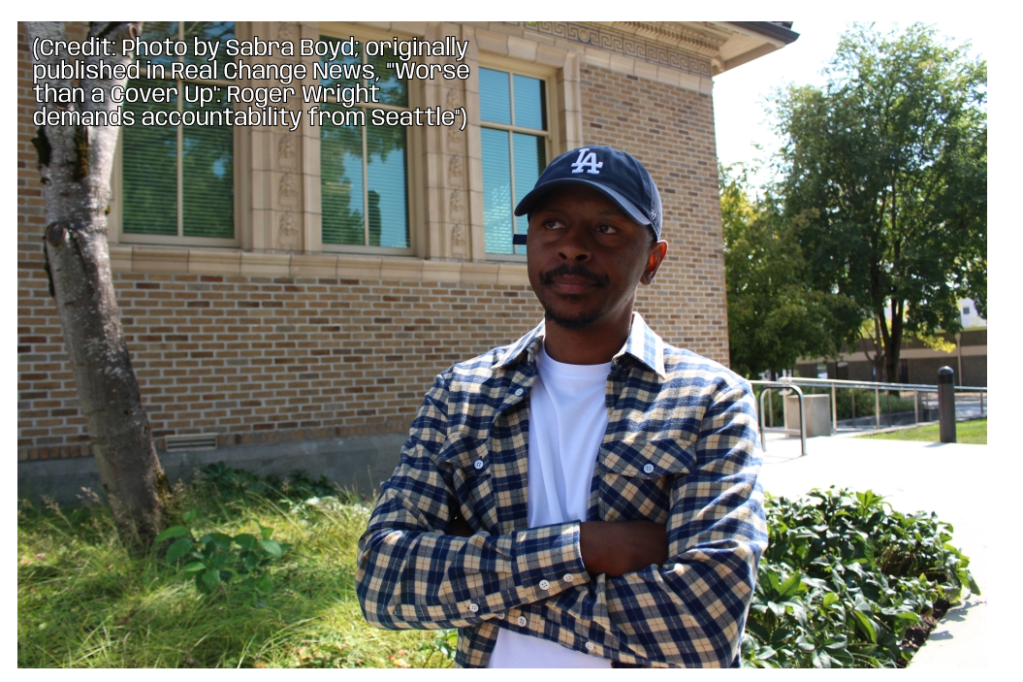
Roger Wright was 19 years old when he stepped outside his house to make a quick run to the grocery store in October 2004. Outside the store, his life was changed forever. Wright was suddenly grabbed by Seattle Police Department (SPD) officers and…choked unconscious, handcuffed and kidnapped. The next thing Wright remembers is being tasered by police, naked on a freeway onramp at night… Wright has never been provided police general offense or use-of-force reports related to SPD’s encounter with him in 2004, nor was Wright ever charged with any crime… Since the incident, Wright has steadfastly sought accountability through all the official channels of Seattle’s police accountability system, and has appealed directly to Seattle politicians. At each turn, he faced denials and dead ends… Wright believes that’s because of the color of his skin and a…culture aimed at protecting Seattle police across numerous levels of Seattle government. “The reason why they didn’t want to investigate is because Roger is alive,’ [his Mother] said. ‘He made it out of the situation and they just don’t care. It’s like you should be thankful nothing happened other than you got beat up and tasered. It’s the police’s word against you.”
“‘Worse than a cover up’: Roger Wright demands accountability from Seattle,” by Glenn Stellmacher
It has been seven months since Real Change published its searing exposé of a decades-long conspiracy to deny justice to Roger Wright who was beaten, kidnapped, tasered, and abandoned naked on the highway by Seattle pigs in 2004–seven months but no serious action taken on the part of local politicians and public officials who are well aware of Roger’s story. Why the silence? Where is the outrage? Where are the calls for justice from so-called progressives? Because Roger’s story lays bare the corruption of the Seattle political machine and the lengths it will go to protect the police, these same “progressives” understand it to be in their best interest to sweep under the rug a clear case of attempted murder, falsification of records, and blatant political repression. Roger’s fight for justice also neatly indexes the twists and turns and ultimate failure of attempts at “accountability” and “reform” of the Seattle Police Department, infamous for its trigger-happy pigs and use-of-force violations.
Once we understand that the real purpose of “police accountability” is to silence calls for justice while protecting the pigs, we can move with urgency and clarity to develop what’s been missing all along: a militant mass movement capable of weaponizing the system’s hypocrisy against itself. We need to go to the people, rouse their indignation over Roger’s story, and bring them into confrontation with not just the cops who attacked and kidnapped him in 2004, but the entire system which has denied him justice for over two decades. The fact that Roger is still alive and seeking justice is a testament to his steadfastness in the face of overwhelming hostility from SPD and the institutions that protect them–but he shouldn’t have to face the enemy alone.
To understand the implications of Roger’s story, we have to understand that the attack and kidnapping were only the beginning. Glenn Stellmacher’s article for Real Change lays out the basics: after being picked up again by SPD on I-5 that night in 2004, Roger was taken to Harborview Medical Center where his medical records were falsified and his family lied to. “In the days which followed,” he would later write, “I found myself over-analyzing everything around me. I had trouble sleeping, and I experienced nightmares. Several times, I woke up in tears. I was fearful of encountering the police in any way, and that feeling stayed with me for several years.”
Confused and without an explanation of what happened that night, Roger’s family was inclined to believe the narrative of the police: that he had been high on PCP (a toxicology report obtained later definitively proves otherwise) and was randomly found walking down I-5 naked, bruised, and bloody. His relationships with his loved ones became strained as paranoia set in alongside other side-effects of the powerful anti-psychotic medication, Haldol, which was given to Wright against his will by staff at Harborview Medical Center that night: “For over a year, the voices continued to plague my mind and encourage me to commit suicide. Years later, after speaking to a therapist, it was recorded that I had developed Post Traumatic Stress Disorder (PTSD), which lasted for over 13 years.” To this day, SPD has denied that the events of October 9th, 2004 ever took place.
In 2006, Roger was stopped outside his father’s home by SPD on grounds that Wright was acting “suspicious.” The officer then forcibly removed Wright from the car and conducted a warrantless search of the vehicle that produced two bags of marijuana. This egregious civil rights violation must be understood as a continuation of the 2004 attack, an escalation in a campaign of intimidation and harassment by a gang of shameless thugs operating out of Seattle’s South Precinct. But when Roger tried to explain this to Richard Hansen, his attorney for the 2006 search-and-seizure case, Hansen brushed aside his well-founded fears.
Hansen refused to file a brief with the DOJ or the FBI to investigate the original 2004 attack and kidnapping, insisting that they needed to win the 2006 case first before going to the feds. But even after that case was won in 2011, Wright was only ever able to compel Hansen to submit a records request from SPD related to the events of Oct, 9th 2004. When SPD claimed not to have any such records–a massive red flag that evidence had been tampered with or was being criminally withheld–Hansen threw up his hands and told Wright that he should be “happy and grateful” for winning his 2006 case in the state Supreme Court.
Hansen also declined to contact his close friend, then-U.S. Attorney of Western Washington and future Mayor of Seattle Jenny Durkan, about Roger’s case and the need for a thorough investigation–ironic given that in the same year, 2011, Durkan’s office concluded an investigation which found SPD to be in violation of the constitution due to a pattern of excessive use of force and a lack of oversight. In Durkan’s own words, “the system designed to respond to civilian complaints against SPD officers…is broken. These systems fail to provide adequate oversight to prevent a pattern or practice of excessive force.” That investigation prompted the City of Seattle to enter into a “consent decree” with the Department of Justice, essentially a period of federal oversight intended to reform the SPD of its vicious ways. Originally intended to last for two years or so, federal oversight of the SPD would continue until September of 2025. And in a turn of events that should shock absolutely no one, SPD’s lethality actually increased over the course of federal oversight while racial disparities in use-of-force cases also grew.
After winning his search-and-seizure case in 2011, Roger took his fight for justice into his own hands only to run into relentless opposition from the very entities tasked with guaranteeing his constitutional rights. Below is a non-exhaustive list of Roger’s attempts to navigate the “proper channels” for seeking accountability and their results:
- Attempted to file a civil rights complaint with the FBI:
- Was escorted out of the building by security without an explanation before he could meet with anyone
- Met with then-city council member and future Mayor of Seattle Bruce Harrell:
- Harrel told Roger that he “just needed to move on with [his] life” and that he couldn’t help
- Hired a civil rights attorney specifically to file a brief with the DOJ that included information about the 2004 incident.
- This lawyer also refused to do so, focusing only on the 2006 search-and-seizure case
- Filed a complaint with the Office of Police Accountability (OPA):
- Despite strong evidence related to the Oct 2004 attack and kidnapping–evidence he gave the OPA himself–the OPA declined to open an investigation. In an email to Roger after the fact, the then-president of the OPA wrote, “There was no obligation to report force that was not used,” and that “there was simply no evidence supporting” Roger’s complaint.
- Filed a complaint with the Office of Inspector General for Public Safety:
- OIG staffer Anthony Finnel told Roger, “despite whatever facts you bring, I’m going to take the cops’ word over yours” and declined to open an investigation.
- Went to the Seattle Community Police Commission (CPC), an allegedly independent body of “community members” created as part of the federal consent decree which “reviews and provides input on the police accountability system.”
- Roger finally found a sympathetic audience in the form of former-staffer Felicia Cross who tried to platform Roger’s story through the CPC. She was immediately shut down by Executive Director Cali Ellis and co-chairs Joel Merkel and Harriet Walden, the latter of whom described Roger’s story as “a waste of [her] time.” In response to questions from Real Change, CPC communications director Kieryn High said “the CPC doesn’t have the authority to investigate misconduct or compel SPD or other accountability agencies to take specific actions.”
- Requested a civil rights investigation from the DOJ
- They replied that the DOJ was “not able to investigate matters involving a single complaint of alleged misconduct, however meritorious.” They suggested he reach out to Seattle’s OIG or the FBI.
In our own conversations with Roger, he’s described feeling like “an enemy of the state” merely for staying the course in his fight for justice. It seems that with every attempt to engage the bureaucratic labyrinth of “police accountability,” the functionaries of that system grow more tenacious in squashing his efforts. For many, this phenomenon of civic and federal institutions operating in direct opposition to their stated purpose may seem baffling.
Whenever the pigs’ cruelty reaches some new extreme (for instance, the 2010 murder of John T. Williams) spontaneous outrage follows which pushes politicians and officials–especially those with a rhetorical commitment to “progress”–to respond with seemingly-urgent maneuvers (the 2011 DOJ investigation; the 2012 – 2025 consent decree) and a symbolic recognition of wrong-doing. If we don’t look too closely, all this bureaucratic action has the appearance of the system kicking into high gear: tax-payer money gives birth to special task forces staffed by experts in their fields who produce evidence-driven reports that recommend innovative policies which become the pet projects of up-and-coming progressives who make a career off people’s pain only to deliver them bloated institutions that, when push comes to shove, claim impotence and pass the buck.
In reality, “police accountability” only gives a rubber stamp to ruling-class terror. Policies, procedures, audits, and oversight committees may seem onerous to individual pigs who would prefer to beat and maim without a paper trail. But the Seattle Police Officer Guild’s tantrums aside, progressive reforms are, for the pigs, the gift that keeps on giving–especially when those reforms literally close the book on cries for justice. Ask the parents of Charleena Lyles what they think of the “reformed” inquest process that vindicated the cops who killed their daughter and justified prosecuting attorney Dan Satterberg’s decision not to file criminal charges. Better yet, ask Roger Wright if he thinks the solution to all the criminal malfeasance he’s faced from the OPA, OIG, and CPC is yet another municipal body to provide oversight to those tasked with providing oversight.
Roger’s demands are for clear-cut executive actions which any civil servant with an ounce of integrity would immediately endorse and pursue. And yet a slew of lefty politicians from Katie Wilson to Kshama Sawant to Alexis Rinck, who are all well aware of Roger’s story, have shown him nothing but cold disregard. The only exception to the rule has been State Rep. Shaun Scott who at least acknowledged Roger’s fight for justice in a newsletter from October of last year. “None of Seattle’s police accountability agencies have made much progress on actual justice for Roger,” he wrote, “and many Seattle-area politicians have been less than responsive to him.” Well, Shaun, it’s been crickets since then! If you don’t want your name added to the list of opportunists and careerists who have leveraged the suffering of the masses for their own gain, use your influence to endorse Roger’s demands (see below).
For those of us who know better than to rely on the moral integrity of politicians, we owe it to Roger to not just amplify his story but to devote ourselves to making his demands into material reality. Rallying masses of people around Roger’s cause, arming them with organization and political clarity, and unleashing their righteous indignation is the only guarantee of success. As Dare to Struggle our role is to ignite the people’s outrage at a system which bends over backwards to protect criminal politicians and killer cops. Only then can we mount the escalating pressure necessary to achieve Roger’s demands:
- An independent investigation by the WA state Attorney General into the events of Oct 9th, 2004 and the decades-long cover up which followed
- Jail all the cops involved in the attack and kidnapping:
- Prosecute anyone involved in the subsequent coverup–from SPD dispatchers to Harborview medical staff to the public officials who weaponized “police accountability” procedures to deny Roger justice
If you want to join Roger’s fight for justice, if you’re sick of the reformist death loop that got us here, if you want to learn how we can collectively move the needle toward real liberation, reach out to daretostruggleseattle@proton.me or message us on Instagram at @DareToStruggleSeattle to tap in.
JUSTICE FOR ROGER WRIGHT!
JUSTICE FOR ALL VICTIMS OF POLICE BRUTALITY AND POLITICAL REPRESSION!

