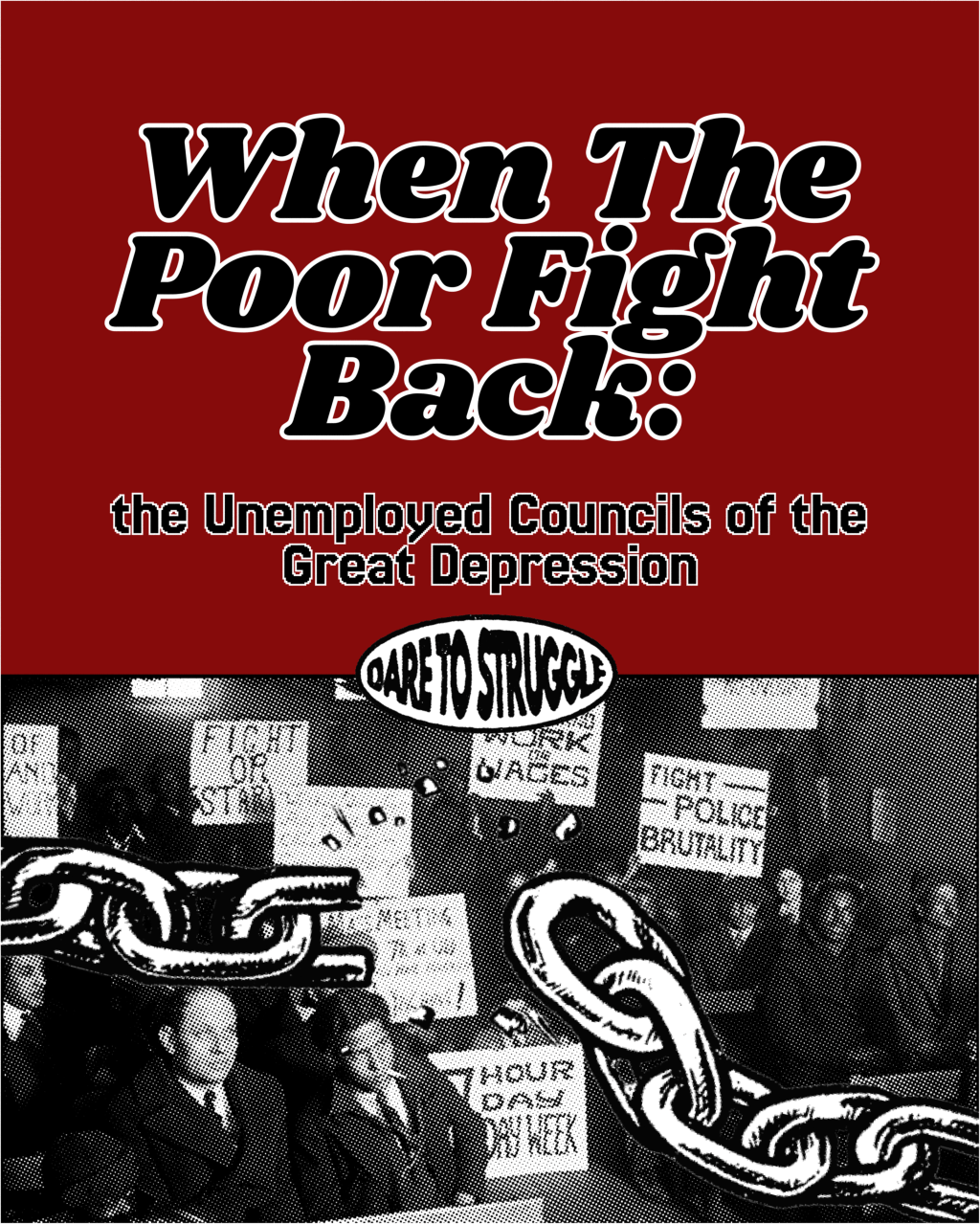
In 1929 the Great Depression came onto history’s stage stinking of death and despair. In the US by 1933, 15 million people were unemployed, with starvation and misery running rampant. This was one of the most devastating crises capitalism ever produced, and the US government had no adequate welfare system to prevent mass starvation and homelessness. By not helping, the US government created an enormous population of pissed off and hungry people seeking to improve their conditions. The Communist Party, USA (CPUSA), back when it was still cool, saw the revolutionary potential in this population. Since these unemployed and homeless people were very recently dispossessed of their ability to survive and the government wasn’t adequately providing for them, they were angry. They saw the need for an organized force to demand relief. CPUSA tapped into this growing reserve of energy and directed it against the system responsible for the masses’ starvation.
In order to secure this energy, Unemployed Councils consisting of unemployed, homeless, and poor people were established by the CPUSA. These Councils put up a fight against politicians, landlords, and the capitalist system as a whole. Through defiant action, they forced the government to open relief stations in poor areas, provide unemployed families with grocery benefits, and appropriate large amounts of money for social services. They put the struggle of unemployed people on the map and showed the US government that if it didn’t act, more and more people would be drawn to this force seeking to overthrow it.
Homelessness is currently increasing in the US. The cost of living is rising. The US is waging wars worldwide. We get brutal scenes of drone strikes and bombings delivered to our phones daily, while people die on the streets here in our own cities. For those of us who are serious about organizing against this system, and recognize the potential for homeless and unemployed people to throw down in a mass movement for change, what can we learn from the Unemployed Councils?
Step up, it works
To kick off the struggle for unemployed people globally, March 6th 1930 was designated “International Day of Struggle against World Wide Unemployment.” Across the world unemployed people rose up to protest the unlivable conditions of the Depression. According to the CPUSA one million people in the US participated in these demonstrations. Whether or not these numbers are inflated, the March 6th protests in the US asserted the unemployed struggle on to the political stage in a massive way. Across the country, the failures of the ruling class to provide for poor people came back around at them like a boomerang, in the form of defiant confrontations between cops, politicians, and angry protesters. In New York for instance, thousands of protesters converged around City Hall to deliver their demands, without a protest permit, courageously fighting back at the cops sent to brutalize them.
The March 6th protests provided an initial avenue for mass outrage, but concrete programs and campaigns had to be waged in order to continue an organized struggle against the horrors of the Depression. Demands for Unemployment Insurance, housing, and an end to police brutality were raised and fought for across the country, with local Unemployed Councils taking up work to strengthen them.
Because the Councils actually confronted the halls of power head on, they were able to secure wins from their local governments. For instance, In 1930 October 16th, the Harlem Unemployed Council disrupted and protested at City Hall, successfully intimidating the government into appropriating one millions dollars for unemployed relief. What were know as “Hunger Marches” were mass demonstrations organized across the country to agitate around the starvation of large parts of the US population. On July 8th, 1932 in St. Louis, five thousand Hunger Marchers brought demands for immediate unemployed relief to City Hall, forcing a special session to be called and eventually coercing the government into granting their demands through mass pressure.
On the days that the Unemployed Councils weren’t interrupting and hijacking government meetings, organizers were moving evicted tenants back into their buildings. These bold actions became such a phenomenon that, in cities like Chicago and New York, multiple people were getting moved back into their apartments every day after being evicted. Often the spectacle of pulling the reverse UNO card on landlords sparked impromptu protests and speak-outs by residents and activists. This creative solution allowed the Unemployed Councils to draw people into political struggle while also improving their immediate conditions.
Unemployed Council organizers also recognized the specific oppression that Black people faced in the unemployed and homeless struggle. The liberation of Black people and recognition that they were unemployed at higher rates than white people, facing the brunt of the worst conditions, was put at the forefront of the Unemployed Councils work. For example, Hunger Marches in the south made it a point to defiantly protest segregation, with Black and white organizers fighting shoulder to shoulder against the cops. The national Hunger Marches to the US capitol raised demands to end the particular discrimination of Black people by unemployed relief charities and the extreme police brutality they faced.
The Unemployed Councils also consistently agitated around the unjust and racist trial of the Scottsboro Boys (9 Black boys framed for the rape of two white girls in Scottsboro, Alabama). As historian Mark Soloman put it in his book The Cry Was Unity, “Scottsboro and hunger became inseparable issues.” An inspiring connection today considering the amount of racist and political repression across the country. What would a defiant homeless struggle throwing down against the mass deportation of immigrants, or against the repression of the Prairieland Defendants look like?
Fight or feed?
The day to day fight put up by the Unemployed Councils is inspiring in its own right. But, while millions of unemployed and homeless people came out for protest, many less became actually involved in the operation of the Unemployed Councils. Often they were held up by CPUSA activists for the majority of their existence, did some rad shit, but still struggled in organizing masses of unemployed and homeless people to take up political work as their own. For people who are serious about organizing around these issues now, there will need to be a shift in making these organizations a genuine grassroots effort involving mass participation.
Though the above mentioned point was a major shortcoming, the Unemployed Councils actually wentto people to try and organize them against their oppressors. They did not take a paternalistic approach to improving the conditions of poor people. Instead, they saw the masses of poor people as fighters, and makers of history, rather than just bellies to fill. The Councils spent countless hours passing out flyers and talking with people, doing soap-box agitation on street corners, and organizing on-the-spot meetings on the street to get people involved in political work. This approach seems to have been forgotten today by most organizations that want to stand with poor people.
Instead of just viewing people as bellies, we should take from the Unemployed Councils and actually approach people with radical politics. The potential for the masses of poor, homeless, and unemployed people to fuck shit up for the ruling class hasn’t changed since the 1930’s.
What’s it gonna take?
Starting by going to the masses of unemployed and homeless people, we can begin to get a sense of what concrete organization could look like. This will require getting to know the common struggles of people living on the streets, in section 8 housing, or in other areas where poor people are pushed into. We should create organizations capable of using these struggles as an engine to move forward, creating campaigns and demands that can be waged against the system. Organizations like Homeless Liberation Initiative, an organization that is firmly rooted among and starting to be led by former and currently homeless people, will need to grow. Efforts such as this should be built among homeless and unemployed people across the country to create a strong basis for waging campaigns that can actually put pressure on the US government.
Come to the Dare to Struggle conference this summer June 12-14th with Homeless Liberation Initiative to begin the tasks necessary for this work. We are serious about organizing homeless and unemployed people into genuine organizations that can take up the struggle for a better world. The Unemployed Councils threw the fuck down for poor people in the 1930’s, but almost one hundred years later we are still facing similar shit. It’s time that we revive the revolutionary spirit of unemployed and homeless struggles. Tap in.
Sources:
Harvey Klehr. Heyday of American Communism. https://archive.org/details/heydayamericancommunism/page/49/mode/2up
Mark Soloman. The Cry Was Unity. https://www.scribd.com/document/235334564/The-Cry-Was-Unity
Mark D. Naison. Communists in Harlem During the Depression. https://archive.org/details/communistsinharl0000nais/page/40/mode/2up
The Daily Worker. https://www.marxists.org/history/usa/pubs/dailyworker/1932/v09-n162-NY-jul-08-1932-DW-LOC.pdf
The CP, the Sixties, the RCP, and the crying need for a communist vanguard party today: A summation, by the Organization of Communist Revolutionaries, of the communist movement in the United States. https://goingagainstthetide.org/2025/09/01/reprint-the-cp-the-sixties-the-rcp-and-the-crying-need-for-a-communist-vanguard-party-today-a-summation-by-the-organization-of-communist-revolutionaries-of-the-communist-movement-in-the-un/
 Dare to Struggle