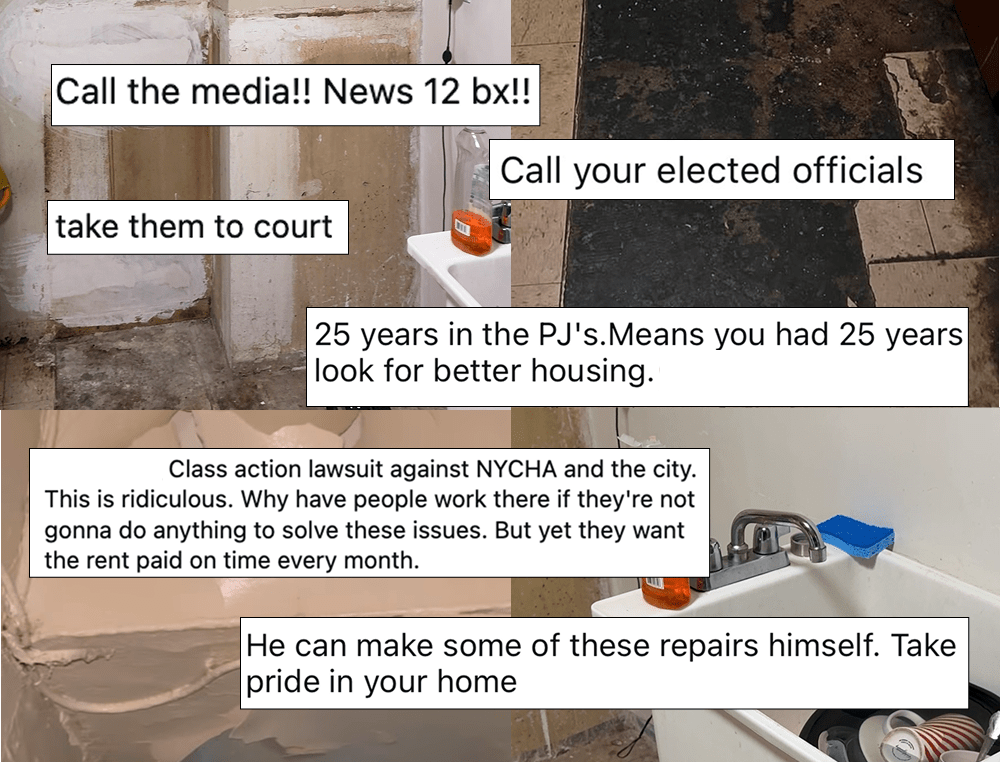
NYCHA residents face an average 415-day wait time for repairs, fears of being displaced by the privatization of public housing, condescension from local nonprofits and management, and broken promises from politicians who claim to serve them. With so much stacked against them, residents are forced to come up with solutions alone and isolated from their neighbors, who are going through similar situations. When they ask for help, they are told to go through a variety of methods.
“File a class action lawsuit!”
“Call this politician and then call that politician!”
“Just leave the projects”
“Do the repairs yourself!”
“Call the news”
Yes, these options are all available, but that does not mean they aren’t dead-ends, time consuming, condescending, and leave residents feeling more hopeless and demoralized. It also does not consider the fact that nearly half a million people are all up against the same mess, and solving one person’s problem will not stop the disrepair and displacement that all NYCHA residents face. Instead of these individual solutions, we think it is only through the power of the people getting together, organized, and unfazed by the dead-end solutions that we can take the fight directly to the people responsible for these problems, confront them, and make them do their job for everyone.
“File a class action lawsuit”
When residents of a development face a disaster that quickly affects a large majority of the people, such as the chimney explosion at Mitchel Houses, people are quick to tell them to file a class action lawsuit. Despite the genuine obstacles that residents face in trying to find lawyers who care, the larger issue stems from the agreements that come out of these class action lawsuits. (Spoiler alert: NYCHA doesn’t do shit.)
In 2014, in Baez v. NYCHA, lawyers from the National Center for Law and Economic Justice argued on behalf of NYCHA residents who were suffering from exposure to unabated mold and excessive moisture. NYCHA agreed to a settlement in which a judge required them to remediate mold promptly, but within a year it was clear NYCHA was not complying. This has only continued in a cycle for a decade. NYCHA doesn’t comply for a year, and then the judge amends the agreement to include independent officials to do NYCHA’s job. To this day, mold remains and grows within NYCHA units. A 2025 NYCHA Monitorship Report states that NYCHA only completed 28% of mold work orders, falling short of the 95% agreed-upon benchmark.
All these lawsuits in the last decade prove that NYCHA continually breaks its own laws meant to ensure healthy, safe, and livable housing for residents. Neither the courts nor the independent and federal overseers have been able to force them to do the bare minimum. In 2022, Riis residents tested positive for arsenic, and lab results confirmed arsenic in the water. Dare to Struggle organized Riis residents who then came together and exposed the dirty water through bold protests, management confrontations, and in a meeting grilling the then-CEO of NYCHA, Greg Russ, who was forced to step down because of the disaster. While Riis residents were bravely confronting the people responsible, a lawyer went around promising people they would take on the fight against NYCHA. The lawyer never filed a class-action lawsuit and left the scene with his empty promises.
In 2025, tenant advocates with the help of former State Senator Tom Duane sued NYCHA for the demolition of NYCHA’s Fulton and Elliot-Chelsea Houses, being pursued by private management company Related Companies and NYCHA’s vice president for real estate development, Jonathan Gouveia. Supreme Court Justice David Cohen initially rejected the demand to halt the demolition, but after appealing the decision, a different judge allowed a temporary halt and recommended a larger team of judges consider the case. None of this could continue without the courage of 24 residents in the senior building who are refusing to leave. But what happens when the courts lift this temporary halt and the demolition is back on? NYCHA’s CEO Lisa Bova-Hiatt said in response to what will happen if those residents refuse to leave: “To say that under no circumstances are they going to relocate? Ultimately they will.” These are the words of someone who is sure that she will get her way no matter what legal avenue residents take. A movement outside the courtroom must expose the illegitimacy of any decision that destroys the livelihoods of public housing residents. We should not accept defeat once the courts working in NYCHA’s favor likely decide to green-light the demolition of Fulton and Elliot-Chelsea Houses.
Demolition is not the only consequence of privatization, as shown with Harlem River Houses, which was converted to Section 8 housing through the PACT privatization program without a vote. Starting in 2020, Harlem River Houses converted to Section 8 housing under C+C Management and officially finished the conversion in 2022. Residents represented by a lawyer sued the Department of Housing and Urban Development to reverse the privatization of their development. The court dismissed this case based on the judge’s belief that undoing the privatization is “extremely complicated and cannot be undone.” US Circuit Judge Dennis Jacobs claimed that reversing privatization is “like unringing a bell and putting toothpaste back into a tube.” .
The legal system protects and enables government agencies such as HUD and NYCHA and their plan to privatize public housing. Multiple class-action lawsuits, a federal monitor, and plenty of agreements among different agencies and independent officials have left residents in the same spot. No miraculous legal intervention will come about and force NYCHA to stop its scheme of letting its buildings fall apart. It is up to residents to fight for what’s right and to confront those who have wronged the people living in public housing.
“Call your local politician or representative”
Calling your local politicians or representatives to get maintenance done is often just asking for a middleman between you and management. Politicians can act as a liaison, usually regurgitating the same information that NYCHA already provided (or didn’t).
We’ve heard stories from residents who reach out to politicians about an open maintenance ticket. Here’s how it usually unfolds: The resident contacts a politician to report that their maintenance ticket remains unaddressed. The politician agrees to reach out to NYCHA. The politician calls the resident to back NYCHA’s claims and confirm that nothing else can be done. In tenant meetings, town halls, and other performative meetings, politicians will profess their ongoing commitment to making NYCHA a better place. (Seriously, they regurgitate this line until they are blue in the face). Then they hide until the next NYCHA disaster, when righteous, rebellious residents speak out and force those politicians to make an appearance and save face.
In rare moments when residents reach politicians and receive their repair, it comes with strings attached. The same politicians who overwhelmingly ignore or look down upon most residents will reward the few residents who have proven their loyalty to working within the system. Those who don’t rock the boat get to shore, while everyone else is thrown off and left to fend for themselves. For the few people who use this method, the politician gets a happy advocate who sings their praises to their neighbors or online. Despite that, the prospect of getting your own temporary repairs doesn’t fix the crumbling, outdated structure of NYCHA’s buildings. The temporary repairs are only a short-term solution. Meanwhile, politicians advance their political careers, and public housing residents learn that only by being polite to those in power will they receive a few crumbs.
“Call the news”
Calling the news is one way that residents have been able to get NYCHA to notice and do repairs for their apartments. Monica Morales, a reporter for PIX11, has made reporting on the disrepair in NYCHA apartments and then getting those repairs done, her main shtick. According to a profile on Morales in the Columbia Journalism Review, “it wasn’t until January 2018 that a story about heat and hot water outages at the Redfern Houses in Far Rockaway, Queens, made her the foremost chronicler of the city’s public housing conditions. “The calls and emails kept coming in,” Amy Waldman, PIX11’s former news director, recalls. “This story affected entire communities in our area and that became evident. So we felt that we had to stay on it.”
It’s clear that PIX11 sees this as an issue which affects entire communities, but through Morales’ reporting, continues to cover individual cases of disrepair without exposing the deeper causes. Even though Morales and many press outlets are right to report on the atrocities of living conditions in the projects, they focus on individual problems and individual solutions. Reporting on a few residents’ apartments can often get NYCHA to notice the bad press and force them to respond, but that still leaves the hundreds of thousands of other residents to suffer alone. It also creates the illusion that getting the press to come to their apartment will fix all their repair issues, when the reality is often the complete opposite.
NYCHA residents know all too well that even when one issue is fixed, it can come back, and sometimes worse. Even Morales herself admits that the work she does feels useless, as, “A lot of the things we have fixed, we have to go back,” she has said. “There are a lot of bathrooms that are now back with mold. It’s very frustrating because it’s a game of whack-a-mole.” Residents can use the press to expose the conditions of all NYCHA developments as they continue to fall apart across the board. The press is best utilized when reporting on how residents are getting together to speak out against the conditions they all face, even if it’s not in their own unit, building, or development. Individual exposure is not necessarily the problem unless it fails to connect the entire housing agency as the oppressor and the half a million NYCHA residents as the force demanding change.
“Just leave the projects”
NYCHA is the largest public affordable housing provider in the nation, housing 1 in 16 New Yorkers, many of whom have lived there for generations. With a cap on paying 30% of your income, it beats the unaffordable prices of most NYC rentals across the city. Across all 5 boroughs, median rents have skyrocketed with an average of $3,000 monthly. This number doesn’t include the cost of multi-bedroom apartments needed for families.
Regardless of the supposed idea that the projects were meant to be a steppingstone until people suddenly get richer and can afford to leave, the current cycle of staying within the projects is partly because of NYCHA’s own policies. If you get a slight raise or a new job, you must report your new income, and once again it goes up to match the 30% of income threshold. Once you make a little more money, you must put it to rent, which traps residents in a cycle of rising income and rising rent. Telling NYCHA residents to stop relying on affordable housing misses the point. Even if residents wanted to leave, many of the residents you meet in the projects have generations of families who lived there and passed on their apartment. Even if the prospect of getting out of the projects is a goal, these are communities that people rely on, have lived with for generations, and feel a connection to.
Not considering the high prices of rent and the desire to stay in NYCHA for one reason or another, why are we content with pushing Black and Latino residents out of their neighborhoods? Over the last 5 years, the Dominican population in NYC has decreased by 13% and the Black population has decreased by 6% within the last 20 years. These statistics don’t just point to a migration towards more affordable suburbs and cities, but to a concerted effort to displace Black and Latino people from the neighborhoods they grew up in.
Beyond getting out of the projects completely, within NYCHA, getting a transfer to a different development is quite difficult. The average wait time for a transfer after it’s been approved is over 2 years, and this includes domestic violence survivors who are overwhelmingly Black and Latino women. NYCHA puts “emergency transfers” in its lowest priority category, which leaves victims of abuse in the same space as their abuser, with their only option being to go back into the shelter system or onto the street. Funny enough, the highest priority category is for apartments that are unlivable because of health, safety, or environmental concerns. Yet we don’t see residents being quickly transferred because of rampant mold, holes in the walls, leaks and water damage, or lack of heat and hot water in their unit. If that were the case, nearly all NYCHA developments would be classified as uninhabitable. Residents are stuck where they are at whether they want to leave their development or leave the projects. We should not demonize the people who rely on public housing, or government assistance, but rather point fingers at the system that keeps people poor, trapped, and hustling all their life to try to live with dignity.
“Do the repairs yourself”
When you’ve been waiting for your ticket to be fulfilled for multiple years, it is sensible to assume that NYCHA has either forgotten about it, doesn’t intend to do it, or closed it without you knowing. Therefore, doing repairs yourself is a common last resort for residents who are lucky enough to be handy or know someone else who is.
When NYCHA does not fulfill tickets and allows housing developments to fall into disrepair, they are violating the law and tenant lease agreements. When residents do their own maintenance, they are also violating their lease agreements. How come both these things are true, and both continue with no intervention from the city? The reason is that NYCHA is aware of the 600,000 open work orders across all its developments. When residents do minor maintenance repairs that don’t interfere with the infrastructure of the building, it offloads the responsibility from NYCHA to do the maintenance work.
Regardless of these minor repairs getting fixed, residents cannot fix the deteriorating infrastructure of the buildings. Roofs, pipes, elevators, and boilers need serious renovations, as seen by the consistent elevator outages, leaks, and the recent boiler explosion at Mitchel Houses. NYCHA officials state that at “least 180 of the 1,027 boilers it now maintains have yet to come into full compliance with either a proper certificate to operate or a registration with DEP [Department of Environmental Protection].” People who live in NYCHA work their own jobs, pay their rent, come home to relax, take care of themselves and their families, and have a place to sleep and call home. It is not, nor will it ever be their job to do their own maintenance work. In the same way that we don’t expect private renters to do their own maintenance, public housing residents should receive the same treatment.
Conclusion
These options for dealing with the horrific disrepair that NYCHA residents are up against boil down to two things: beg someone else to take care of it for you or suck it up and deal with it. Whether it’s a politician claiming to do you a favor for good publicity, or people telling you that you shouldn’t live in public housing and to just pay the insane rents of NYC, there is a distinct lack of encouragement to get together and fight. There is a small group of criminals responsible for the decay of public housing, and there are plenty more people who enforce the crimes through incompetence, disrespect, and harassing residents. Residents should take the fight directly to these criminals.
When residents are told to rely on all the other options that the system provides, it muddles the fact that there are real people in physical offices responsible for their misery. On top of that, residents continue to face harassment from strangers online who know nothing about them, and even among residents from other NYCHA developments. Rather than aim all this hate towards people who are simply trying to survive and live in dignified housing, we should direct that energy to the evil people behind this mess. Here are a few places to start:

Sources
https://%20https//eapps.nycha.info/NychaMetrics/Charts/PublicHousingChartsTabs
https://law.justia.com/cases/federal/district-courts/new-york/nysdce/1:2022cv02051/576492/54/
“Baez v. New York City Housing Authority.” Nrdc.org, 16 Dec. 2024, http://www.nrdc.org/court-battles/baez-v-new-york-city-housing-authority.
“Dominican Population in NYC Falls 13% since 2021, CUNY Study Finds.” Cuny.edu, 2021, http://www.gc.cuny.edu/news/dominican-population-nyc-falls-13-2021-cuny-study-finds.
Reports — NYCHA Monitorship. “NYCHA Monitorship.” NYCHA Monitorship, 2025, http://www.nychamonitor.com/reports.
Russell, Josh. “Harlem Public Housing Tenants Ask Second Circuit to Block NYC Privatization Plans.” Courthouse News Service, 16 Feb. 2024, http://www.courthousenews.com/harlem-public-housing-tenants-ask-second-circuit-to-block-nyc-privatization-plans/. Accessed 5 Apr. 2026.
Smith, Greg B. “Amid Arsenic Scandal, NYCHA Chief Downshifts Role but Keeps Hefty Pay.” THE CITY – NYC News, 15 Sept. 2022, http://www.thecity.nyc/2022/09/15/gregory-russ-nycha-arsenic/. Accessed 5 Apr. 2026.
—. “NYCHA Boiler That Exploded Was One of Dozens with Expired Permits.” THE CITY – NYC News, 4 Nov. 2025, http://www.thecity.nyc/2025/11/04/mitchel-houses-boiler-explosion-permits-expired/.
—. “Why 24 Seniors Are Holding up NYCHA’s $1.2B Plan to Demolish and Rebuild Chelsea Complex.” THE CITY – NYC News, 25 Mar. 2026, http://www.thecity.nyc/2026/03/25/nycha-chelsea-elliott-fulton-addition-seniors/. Accessed 5 Apr. 2026.
Sterling, Anna. “New Report: NYCHA Traps Survivors of Gender-Based Violence in Danger by Delaying Emergency Transfers – Legal Services NYC.” Legal Services NYC, 17 Dec. 2024, http://www.legalservicesnyc.org/news/new-report-nycha-traps-survivors-of-gender-based-violence-in-danger-by-delaying-emergency-transfers/.
Sundaram, Arya. “The African American Exodus from New York City.” Gothamist, 3 Feb. 2023, gothamist.com/news/the-african-american-exodus-from-new-york-city.
Whitford, Emma. “TV Reporter Makes Public Housing Conditions Her Beat.” Columbia Journalism Review, 2021, http://www.cjr.org/the_profile/monica-morales-pix11-public-housing.php. Accessed 5 Apr. 2026.
 Dare to Struggle