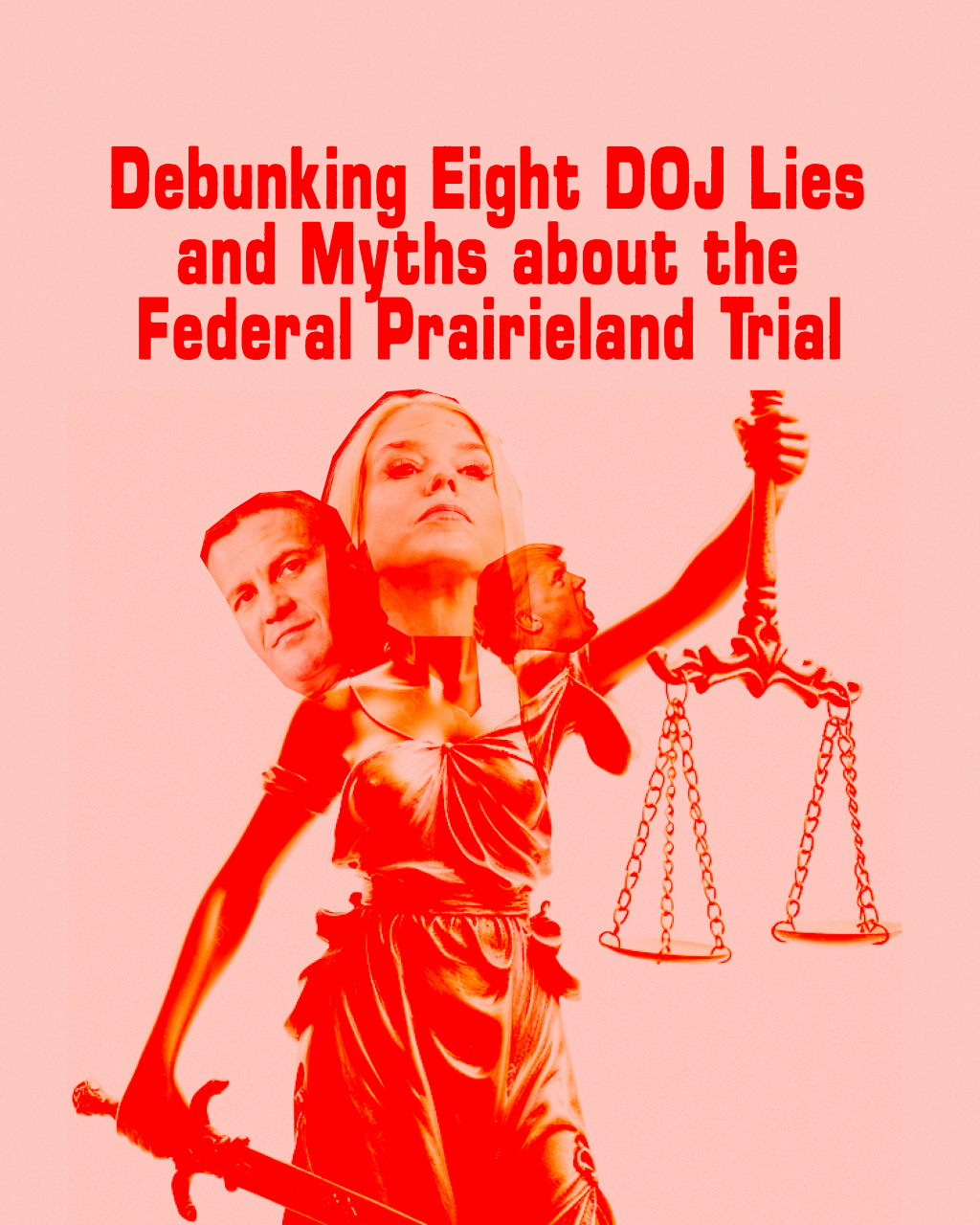
On March 13th, the same day the Prairieland Defendants were found guilty of charges ranging from rioting, providing material support to terrorists, obstruction to attempted murder of a police officer and conspiracy to use and carry an explosive, the Department of Justice posted an article called “Antifa Cell Members Convicted in Prairieland ICE Detention Center Shooting.” This article is filled with lies and twisted facts that serve the DOJ’s political interest of suppressing dissent against ICE and the mass deportation machine. In it they gloss over the house of cards this conviction was built on, such as the circumstances of the trial and the inconsistencies that came out on the witness stand. They attempt to make concrete claims based on shaky evidence. The rising dissatisfaction with this legal process will not be erased so easily, and the dominant narrative can not be allowed to prevail. It is the responsibility of all those who want to see the deportations end to popularize the truth of this political sham trial, to build support for the defendants, and to bring the mechanisms of political repression into the light.
This is everything you need to know about the first Prairieland trial to begin the work of countering the DOJ’s narrative wherever you live.
Myth #1: The federal Prairieland trial was typical of the justice system.
Fact check: The trial was riddled with irregularities and miscarriages of justice. This omission by the DOJ obscures the circumstances of the mistrial and Judge Pittman’s conduct throughout the process.
The DOJ begins its narrative by claiming the trial started on February 23rd and lasted for twelve days. The first day of federal trial, however, was on February 17th, when Judge Mark Pittman declared a mistrial because defense attorney Ms. Clayton was wearing an MLK shirt under her blazer. A judge has the authority to declare a mistrial if they believe something may sway the jury. The prosecution appeared disinterested about the decision and the defense objected. Judge Pittman declared one anyway. He went on to say this may have been the first time in American jurisprudence that a mistrial was caused by a lawyer’s outfit.
On February 23rd a new trial began with a new pool of jurors. Judge Pittman decided that he, himself, should select the jury in the voir dire process, an uncommon command by a judge. In addition to these suspicious circumstances, Judge Pittman denied a motion for attorney MacLean’s counsel to conduct voir dire and moved the overflow trial observation room to a city an hour away. Viewers reported that the live broadcast cut out during the jury selection process.
Judge Pittman also fined defense lawyers multiple times when they advocated for their clients, dissuading defense attorneys from doing their jobs properly throughout the trial.
Myth #2: The defendants were part of an antifa cell.
Fact check: Antifa does not exist as an organization and is instead short for “anti-fascist.”
The government and Attorney General Pam Bondi explicitly state that the nine anti-ICE protesters were part of an “antifa cell” and that one of the trial’s goals was to “systematically dismantle” the cell. However, simply put, there is no such organization called antifa, and cooperating witnesses denied the existence of the organization under oath, repeatedly referring to antifa as referencing anti-fascist ideologies. None of the evidence entered into the court refers to antifa, and there are no logos, stickers, credits, or links to “antifa”. Attempts to characterize certain symbols as “antifa” did not hold up, and even Judge Pittman emphasized that symbols change over time. The zines that the government claims are insurrectionary materials never refer to an organization called “antifa.”
The government platformed an “expert” antifa witness Kyle Shideler (a right wing quack) to testify to the groups alleged “antifa” ties. Shidler peddles his books and analyses on FOX News segments and is a part of an anti-Muslim think tank called the Center for Security Policy. It is a non-profit that the Southern Poverty Law Center designates as a hate group. He testified that he has no relevant degree that qualifies him to be an “antifa expert” (he has a bachelors in English). He said that his work has never been subject to peer review, does not use verifiable data in his analysis, and has never had to present his work to a critical audience. When asked if this case would be good for his career, Shideler testified, “I guess it will depend on how it goes.”
When questioned by the defense about the absence of discussion of violent intent against property or people in defendant groups chats, Shideler illogically claimed that the lack of evidence of this intent is itself actually evidence of intent (???). He claimed that it should be assumed the defendants knew they would be violent, even and especially because it was never discussed. Evidence and testimonies point to the noise demo being a peaceful event.
Beyond calling on Shideler to testify at the Prairieland Trial, the DOJ has been working with him for some time. Shideler wrote the definition of “antifa” used in the indictment of the Prairieland Defendants in the fall of 2025. This definition was adopted by the Trump Administration in the executive order designating “antifa” as a terror group around the same time. Two weeks after putting together the definition, Shideler testified before the Senate about the definition. For those unfamiliar with academic processes, this is a quick turnaround for a definition that can be used to harass, surveil, and brutalize a large swath of the population. Despite Shideler’s lack of credibility, the prosecution, in collaboration with the DOJ and Trump Administration, used this quackery to prop up this sham trial and set a precedent to silence dissidents. It seems like they were hard pressed to find an actual credentialed expert willing to go along with their antifa fantasies and had to make do with a podcaster pundit with big dreams and an on-again, off-again relationship with truth.
Myth #3: The shooting at the Prairieland noise demo was a planned ambush.
Fact check: There is no evidence of this intention and even the snitch’s testimony undermined this erroneous claim.
The thesis of the prosecution’s case is that the nine defendants executed an “ambush” against law enforcement in a planned conspiracy. Sure, some of the Prairieland Defendants planned a noise demonstration, but protesting itself is not a crime, so the DOJ and prosecution had to spin the narrative to frame the planning of a protest as the planning of an ambush. They claim that the shooting was part of the plan—the shooting took place a distance away from the protest as a reaction to police recklessness. They claim it was an ambush, yet discussion among the defendants prior to the protest referred to it as a “safe and easy” type of protest, and numerous defendants objected to anything but that. Two cooperating witnesses testified that they didn’t expect the night to go the way it did, and that there were no plans for property destruction or violence against law enforcement.
Snitch Nathan Bauman stated under oath that his lawyer told him he “had to snitch, even if I have to make shit up,” and he said he took the deal because he was told he faced “fucking capital murder.” This is a blatant lie, Bauman never faced this charge, and no one was murdered. He testified that even vandalism was not “part of the plan.”
Myth #4: The defendants “launched explosives”
Fact check: The defendants set off fireworks that didn’t hurt anyone or destroy anything (it was literally the Fourth of July).
To paint the defendants as terrorists, the DOJ claims they used “explosives” and had an “expert witness” testify to this. The explosives they are referring to are fireworks that the defendants used to make noise for the detainees inside the Prairieland Detention Facility. There were no bombs or devices that were made for the purpose of property damage, just noise. This is not the first time that the government dishonestly claimed that fireworks are explosives for the purpose of repressing and delegitimizing anti-ICE protesters. In June 2025 in LA, the LAPD arrested an anti-ICE protester for shooting fireworks near cops and charged him very harshly, even though there were no injuries. The prosecution and DOJ are twisting facts to divide public support and strategically draw a line between “good protesters” and “bad protesters”. This broad definition of “explosives” and designation of those who do not stay in the sidewalks as terrorists will no doubt lead to protesters policing each other and further repression of rambunctious protesters. The DOJ is relying on people to remain ignorant to the fact that the “explosives” were harmless fireworks, not bombs.
To further discredit the prosecution and the police, their “bomb expert,” Steven Brenneman, overstated his credentials by two years, had never been to Prairieland, and was unaware that no property had been damaged by the fireworks. Brenneman admitted to shipping the “explosives” through FedEx without any kind of hazard label, undermining his testimony that the defendants were wielding dangerous explosives.
Myth #5: Zines are insurrectionary materials.
Fact check: Zines are small pamphlets that anybody can write, and the zines in question conveyed no plan for insurrection, only political speech.
Among the charges the defendants were found guilty of, Daniel “Des” Estrada was found guilty of “corruptly concealing a document or record” and “conspiracy to conceal documents.” Another defendant, Maricela Rueda, was also found guilty of conspiracy to conceal documents.
This charge is referring to the most absurd arrest in the trial. Two days after the noise demonstration protest, the police pulled over and then arrested Des while he was driving with a box of anarchist zines and personal belongings in his car, from his house to his parent’s house. Des’ wife, Maricela Rueda, called him when she was arrested, and that is why Des was on the police’s radar.
None of the zines or pamphlets had any plans or instructions on insurrection. Possession of political literature is a First Amendment right, which was upheld by the Supreme Court in Gitlow v. New York in 1925. The defense described the box as containing a love letter and nothing produced after 2022. Prosecution claimed that the mere act of moving a box following the arrests of his friends and wife is enough to prove that Des was “corruptly concealing documents or records,” though the content of the items in the box did not contain anything more than personal effects and political speech.
Myth #6: All defendants dressed in black bloc, so that means they are “antifa.”
Fact check: Some were dressed in regular clothes, and fashion choices are protected political speech.
In the Department of Justice’s article, it qualifies wearing black bloc in the charge of rioting. One defendant was wearing her work uniform, which just happens to be all black. Snitch Nathan Bauman testified to learning about black bloc on Tik Tok. Wearing all black is a widely used tactic to avoid doxxing. Black bloc is not an “antifa” uniform. Linking fashion choices to terrorism is crossing a line that will open up the possibilities for law enforcement to crack down on protesters and others based on how they are dressed. Is this the kind of power we want the government to have?
Myth #7: People brought firearms to shoot them at the noise demo.
Fact check: There is no evidence of this.
People from Texas carry guns proudly. Protesters had legally-owned guns properly stored in their vehicles two football field lengths away from the noise demonstration, and some chose to open carry. This is not an uncommon practice for protesters for two reasons that were referenced during the trial:
1) for self defense against right wing counter–protesters
2) to act as a deterrent to police violence
The prosecution argued that the protesters showed up to this protest with the intention to kill, but were unable to prove this claim, as numerous guards crossed the protesters’ paths without harm, and shots were only exchanged when a police officer drew his weapon first and aimed it at a retreating person. They consistently attempted to distract from the stated purpose of this noise demonstration: to make noise for the detained immigrants and to stand with them from the outside. Multiple witness accounts described the defendants as attempting to be seen and heard by detainees inside Prairieland.
Texas is also a state where violence against trans people is common. The Prairieland Defendants describe themselves as a queer friend group and several of them identify as trans. Protesting against ICE, or any agency with a violent bootlicking fan club, opens up the opportunity for right-wing Wack jobs to retaliate. We have all heard of psychos running over protesters with their cars, shooting up demonstrations, and assaulting students during school walk outs. Being trans, on top of protesting ICE, can be reasonably expected to incur reactionary violence. The Prairieland Defendants carry to protect themselves and others. It is not illegal to bear arms. It is not illegal to defend yourself. Having guns is not an indicator of the Prairieland Defendant’s capacity for terrorism, but rather a reflection of the violence trans people faces in Texas on a daily basis, commonly at the hands of police themselves.
Myth #8: Song planned to shoot towards Officer Gross.
Fact check: Officer Gross admitted on the stand that he had pointed his weapon at a retreating person prior to ever hearing gunshots. He introduced violence to the protest with his reckless actions.
Song’s defense attorneys tried to make an argument of defense of self or another. They said, yes, Song did shoot, but it was an act of defense of another because Officer Gross was pointing a gun at a retreating person, presumably about to shoot them. Attorneys argued that Song shot “cover fire” at the ground near the officer, with no intention to kill him. Body cam footage from the officer shows dust rising around the officer. The injury sustained by the officer is consistent with a bullet ricocheting off the ground and required only six stitches and less than 24 hours in the hospital.
Judge Pittman decided the defense of self or others argument in this case was legally invalid because the defendants had set off fireworks and damaged property, prompting a law enforcement response. This choice was entirely up to the judge, and despite five objections, he prevented the jury from hearing the events in the context of self-defense, and it was off the table for the jury to consider this in their verdict.
“The Full Force of the American Justice System”
In this article, ICE official Todd M. Lyons says “the calculated, violent attack at ICE’s Prairieland facility was an abhorrent way for antifa terrorists to ‘protest’ the way this agency enforces the law — but these verdicts make clear that those who choose violence over lawful expression will face the full force of the American justice system.”
The “full force” that Lyons refers to is the torture, coercion, medical neglect, and breaking of peoples’ spirits that the government subjected the defendants to. They tortured defendants by lying to them about their sentences, berating them for months, and denying them basic medical care and proper nutrition. The brutality of the State’s repression and insidious plea deals only exposes their fear of dissent; they are truly scared of people rising up against the mass deportation machine.
In addition to the pattern of coercion and torture in the American justice system, the DOJ seems to be trying to convince people that this wasn’t a rigged trial, never acknowledging that the judge presiding was appointed by Trump and that he acted shady throughout the trial.
The DOJ was happy to craft a narrative prior to the trial for the media to peddle on their behalf. Directly following the July 4th incident, Pam Bondi characterized the Prairieland Defendants as “domestic terrorists,” a term she seems content to slap onto anyone she disagrees with. We have also recently seen this designation used to justify the murders of Renee Good and Alex Pretti. It is nothing new and perhaps even a foundational aspect of the American justice system: when the DOJ doesn’t have the evidence to convict, they wield the power of narrative to extrajudicially convict their enemies through the media. The “law” does not matter to these people, they will let killer cops go free, rich creeps hold power, bomb school children, and terrorize and kidnap people without blinking an eye. They wield the justice system as a tool to legitimize and protect their grip on the current order, and this is a sharp example of this process.
Following the events of July 4th, many organizations resisting ICE terror stayed quiet (including us) while the Prairieland Defendants were politically persecuted, only now stepping forward to stand with them. We need to understand that defending the Prairieland Defendants is defending the movement against ICE. We need defiant action against the mass deportation machine, and if we roll over and let the state crackdown on those willing to step out and say no more, if we distance ourselves from those facing political repression, then we will have no chance to win. With the upcoming state trials and appeals processes, we hope to see more people step forward and take up the cause of exonerating the Prairieland Defendants in the streets. People should go door to door to spread their story, counter the mainstream libel, and put the deportation system itself on trial. People should build support through actions in your city or town, demanding freedom for the Prairieland Defendants and all detainees, the end of the deportations, the end of abuse and neglect in US jails and prisons, the criminal prosecution of murderous ICE agents, and the end of this American Nightmare. This guilty verdict is devastating, but it must not become demobilizing—it is right to rebel against ICE. Free the Prairieland defendants!

