

Immigrants Stand With the Youth and Stand Up Against ICE
On March 21st, Dare to Struggle is calling for nationwide speakouts in immigrant neighborhoods that encourage immigrants, their families, and people who have faced repression for protesting ICE to come into the streets to share their stories. For the defiant youth and those who’ve experienced repression for protesting ICE, we ask that you help us Break the Silence (¡Rompe’l Silencio!) in immigrant neighborhoods and call on parents, friends, and neighbors to join us in the streets to voice their problems, reclaim their dignity, and become leaders in the fight to SMASH the deportation machine!
Breaking the Silence
US government intervention abroad has devastated people’s lives and forced them to travel thousands of miles to the US looking for a better life. Many spend years performing back-breaking labor as agricultural laborers, factory workers, and as domestic and custodial workers, often with little pay or protections because of their immigration status. The conditions of exploitation they experience are purposeful and backed by an immigration system that decides who is and who isn’t worthy of a dignified life.
From the longstanding US “war on drugs” in Central and Latin America to recent racist characterizations against Somali’s and Haitians in the US as fraudsters and pet eaters, crafted narratives of immigrants as criminals and deviants have allowed the Trump administration to shore up support for attacks and violence against these populations whether by government forces, vigilante groups, or private citizens, and fuel allegations of criminality or cruelty that warrants deportation. Obama marked 2 million people for deportation, calling them “criminals, gangbangers, and people who are hurting the community.”1 Two-thirds had only minor traffic violations on their records. Of the thousands detained by Trump’s ICE, 74% have never been convicted of a crime2. These lies serve to obscure the true criminals (the US Government) and isolate immigrants from US citizens who probably have more in common with immigrants than those operating the deportation machine.
Immigrants at risk of deportation and their families have largely been in the background of mass protests against ICE terror and kidnappings. Many have been forced to remain inside for weeks and even months on end, while well-meaning people support them with food assistance, child care, rental assistance, and remind them to “know their rights” in encounters with federal agents.
It’s encouraging to see the level of care and kindness people are extending to their immigrant neighbors, but without stopping the deportations and detentions. Mutual aid, know your rights trainings, and rapid response networks have created a situation where immigrants and their families are kept in the shadows, to hide and cower as the federal government wages war on their neighborhoods. This is no way to live. While we recognize the real risks of immigrants to make their voices heard and protest, we reject the claim that immigrants cannot take leadership in the struggle against the deportation machine and fight for their dignity.
Last June, four immigrants escaped the Delaney Hall Detention Center in Newark, New Jersey. Their escape came after inmates confronted the guards for withholding food and other poor conditions at the facility. Crowds of supporters and family members supported the immigrants inside, confronting federal agents demanding their freedom. The escapees were eventually found and returned to detention, but breakouts at detention facilities continue as immigrants demonstrate they are willing and able to take their freedom into their own hands. This January, about 1,500 immigrant families protested inside the South Texas Family Detention Center in Dilley, Texas. Already facing inhumane conditions inside, immigrant families stood up defiantly against their detention, demanding “Libertad para los niños!” and “Let us out, let us out!” Families could easily face brutal relations and even death, but showed immense courage and, despite the risk of retaliation, boldly demanded their freedom.
Immigrants must be at the center of conversations and the fight to end their oppression. Dare to Struggle kicked off the Spring Surge to Melt ICE campaign on February 13th by coordinating nationwide school walkouts. That day, 3,000 students, many from immigrant families and representing multinational backgrounds, took to the streets in protest of ICE terror and in love and support of their families, friends, loved ones, and neighbors. Many have faced repression for walking out in the forms of suspensions, expulsions, and arrests. Dare to Struggle, and supporters came together on February 28th to host forums against political repression to show students and supporters that we had their backs and we could overcome repression and fight harder against the system. Since then, students have staged more walkouts, hosted press conferences, and spoken out in protest of their repression. The bravery of students and their continued resistance, even in the face of repression, shows what is possible and that more and more people can step forward in protest against the deportation machine!
On March 21st, speak-out against ICE terror in the streets. Break the Silence!
What is a speak-out?
A speak-out is an organized gathering where people are encouraged to speak about themselves and their families, the problems they are facing, and also speak bitterness, or speak against a person, a group of people, or the system that is causing them harm or depriving them of their dignity.
On March 21st, we want immigrants and their families, people who have faced repression for protesting ICE, students, and anyone else who is sick and tired of ICE’s reign of terror, to speak out against the ICE Gestapo troops and DHS. We also encourage people to speak out about other aspects of their lives or situations that they are struggling with, whether sharing personal or family history, problems affecting their neighborhoods or livelihoods, fears, and hopes for the future.
What do we hope to accomplish?
We believe the oppressed have the power to transform their lives for the better and want to empower them. In these speak-outs, we want people to speak openly about their lives, the problems they are facing, and who they hold responsible. By identifying these things, we can make concrete plans to act against them and bring people into collective struggle to end their oppression.
How do I organize a speak-out?
To build for your speak-out, you’ll need to figure out an outside location and a time to have it. You also need to make plans to go out and talk to people, make connections/establish a relationship (e.g., exchange phone numbers or have a follow-up conversation), and see who wants to help plan or be a part of the speak-out. In the build-up, let people know these speak-outs are part of Dare to Struggle’s Spring Surge to Melt ICE campaign and will be happening across the country on March 21st, and that speaking out alongside many others is a powerful way to show that people are coming together to make their voices heard.
Have some ideas of where to start? If you have a crew of people and/or some ideas of where to host your speak-out (e.g., if you live in a neighborhood with a strong immigrant presence or have an idea and connections to a place where you could host a speak-out), start by setting the time and location for the speak-out on March 21st.
Students: Did you lead or participate in a walkout against ICE? Plan a speak-out at/near your school! Go to your neighborhood or the neighborhood your school is in to get the word out and invite people to come.
Once you select the time and place, update your flyer (see toolkit). Then, get some people together and start conducting outings in and around that neighborhood to promote the speak-out. An outing is when you go out with flyers/posters to talk with people about your event, explain what you’re doing, and invite people to participate. During your outing, you should not only talk to people about the speak-out but also emphasize why people should attend and identify those who want to help organize it. For every contact you get, make sure you stay in touch. If you get a handful of people who want to help with planning, set up a planning meeting to organize additional outings and the details of the speak-out (roles, speakers, materials).
Don’t know where to start? If you don’t have a good idea of where you’d host a speak-out or how to get started, start by doing some research. Look at the news. Has ICE been near you? Have they conducted raids in any specific locations? Are there pockets of immigrant communities in your city? Are there Spanish-speaking businesses or cultural centers, churches you could flyer at? Pick an area and conduct an outing where you start talking to people. If you have a friend or crew of people who are interested in building for the speak-out, have them join! On these initial outings, talk to people about the speak-out, why people should attend, and ask if they’d want to help you organize it. If you get a handful of people who want to help with planning, get their contact information and set up a planning meeting to finalize a location and time for the speak-out. Then, together, you can schedule additional outings to continue promoting the speak-out.
Stay in touch with ALL your contacts and anyone you meet on outings to keep them a part of the planning and build-up process.
Lastly, host a final planning meeting the week of the speak-out to assign roles and finalize logistics, and join Dare to Struggle’s National Zoom Planning call on March 15th, 4 pm PT/6 pm CT/ 7 pm ET to meet other organizers and share your plans.
How do I promote it?
- Make videos promoting the speak-out. Since speak-outs will be organized across the country on March 21st, this is a good thing to stress in your videos.
- Content of videos:
- E.g., what is a speak out and why should people attend?
- E.g. Interviews with people in the neighborhood expressing their stories and problems
- E.g. Interviews with youth expressing their stories or problems
- End with a call to come out to the speak-out: e.g., “Immigrants and their families should no longer be in the shadows while the government attacks their neighborhood, kidnaps their loved ones, and denies them their dignity. They have a right alongside us to speak about their problems and fears. On March 21st, we’re organizing nationwide speak-outs in immigrant neighborhoods. Locally, you can join us [insert time and location]. Let’s come together and make our voices heard!”
- Video logistics
- Conduct interviews in the preferred language of your interviewee
- If you don’t speak the language, ask for assistance in translation from people you meet in the neighborhood, and encourage people to take the lead and interview each other
- Video Roll- out
- See below timeline
- When you post the videos, collaborate with @daretostrugglenational on Instagram. You could use your personal Instagram account or set up an account for the speak-out.
- Content of videos:
- Host a reading discussion
- A reading discussion is a good way to bring people together to talk and think critically about issues that may be affecting them or people they know. It is a great way to learn more about people, their ideas, and how they see the world. You should ask each other questions and challenge each other’s viewpoints with respect. Below is a suggested reading list, but you’re welcome to select other readings. If you want to host a reading discussion, hit us up on Instagram @daretostrugglenational and we’ll help you get set up.
- “Liam Ramos was one of hundreds of children at that detention center. Release them all.” Elora Mukherjee
- “The Great High School Rebellion” Part V of Set the Night on Fire: LA in the Sixties, Mike Davis & John Wiener
- “Whistles won’t stop this: The immigrant proletariat and state repression from Chinese exclusion to the Bovino boys’ terror“, Pat Grant
- Dispatches from the Battle of LA, Dare to Struggle
- A reading discussion is a good way to bring people together to talk and think critically about issues that may be affecting them or people they know. It is a great way to learn more about people, their ideas, and how they see the world. You should ask each other questions and challenge each other’s viewpoints with respect. Below is a suggested reading list, but you’re welcome to select other readings. If you want to host a reading discussion, hit us up on Instagram @daretostrugglenational and we’ll help you get set up.
- Conduct Outings
- Flyer at your school, a busy transit area, or a shopping center
- Get a small crew of 2-3 people
- Set up a table or make a sign to hold that says “Nationwide speak-outs March 21st, speak out against ICE” or “What is life like as an immigrant in this country? Share your story during nationwide speak-outs on March 21st.”
- Essential Materials: Flyer, phone (for interviews, pics, and collecting contact info)
- Suggested Materials: Posters, tape, clipboard, contact sheet, pen, table
- Tape up flyers in the neighborhood where you want to host the speak-out, hitting up local businesses in the process. If your speak-out is happening during business hours, ask the business if they’d be willing to close or if they could help supply the speak-out with water and a bathroom.
- Get a small crew of 2-3 people
- Essential Materials: Flyers/posters, tape, phone (for interviews, pics, and collecting contact info)
- Suggested Materials: Clipboard, contact sheet, pen
- Flyer at your school, a busy transit area, or a shopping center
How long should it last?
60-90 minutes.
How do I run a speak-out?
At a speakout, the MC makes an opening statement, leads chants, and invites people to come and speak on the megaphone. From there, other helpers can go around the crowd and collect a list of people who want to speak for the MC, who will keep the speak-out going.
- Supplies
- Megaphone
- Chant Sheets
- Contact Sheet
- Posters and signs
- Banner (optional)
- Assign Roles
- MC: person responsible for welcoming people and giving a speech to open the event. They’ll lead chants to keep the energy high between speakers, and will pass the megaphone to people who want to speak.
- Crowd surfer: person responsible for letting the MC know who wants to speak next.
- Media: person responsible for taking photos of the event and getting videos of people speaking for a recap post on social media, and collaborating with @daretostrugglenational and emailing footage to daretostrugglenational@proton.me.
- Poster/Chant sheet distributor: person responsible for giving out posters and chant sheets as people join.
- Contact person: Collecting people’s contact information and inviting them to the next event.
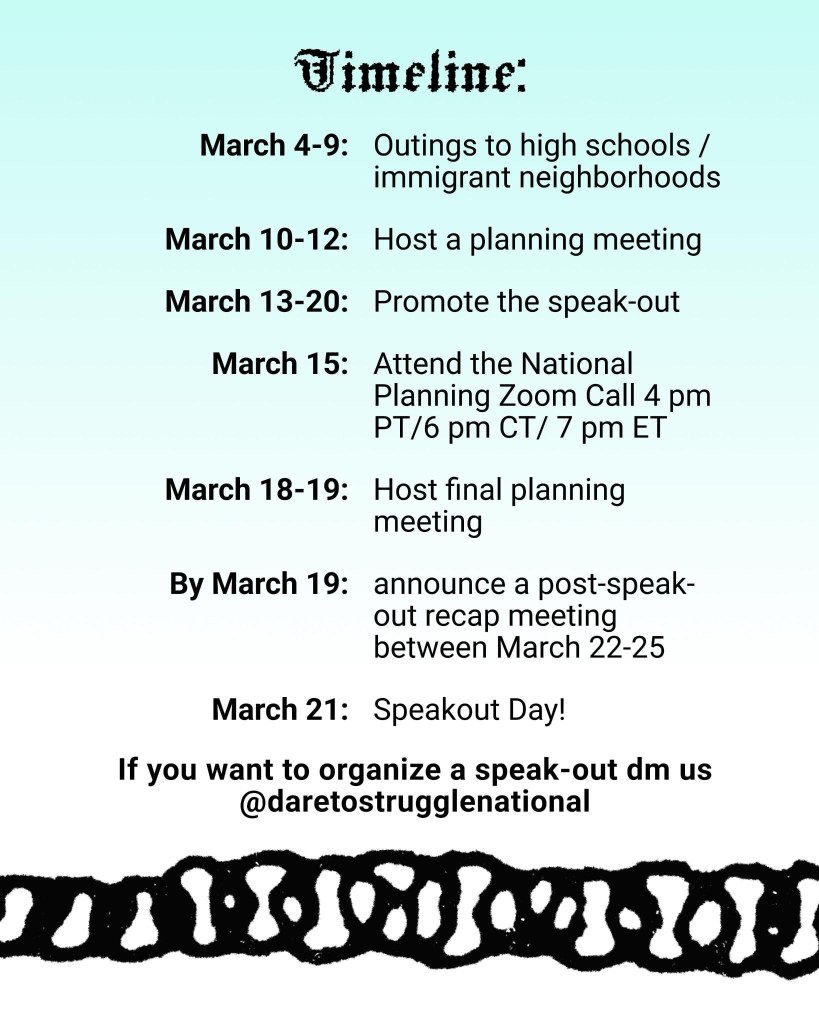
Timeline
March 4-9: Outings to high schools / immigrant neighborhoods
- Talk to youth and parents at local schools, find some students who want to roll with you
- Hit up busy transit areas to talk to people
- Talk to local businesses
Review the “How do I organize a speak-out section?” Regardless if you already know your plan or not for the 21st, use these outings to get yourself started.
March 10-12: Host a planning meeting
- Settle on a location and time for the speakout (if not already done)
- Make plans to promote the speakout
- Make a list of supplies you’ll need and make plans to gather them
- Assign roles for the speak out
March 13-20th: Promote the speak-out
- Make videos promoting the speak out, and when you post them, collab with @daretostrugglenational on Instagram. You could use your personal Instagram account or set up an account for the speak-out.
- Put up posters around the neighborhood you want to host the speak-out, and in local businesses
- Flyer on busy corners, outside of schools, by shopping centers, and near transit hubs.
March 15: Attend the National Planning Zoom Call 4 pm PT/6 pm CT/ 7 pm ET
- Meet DTS and others organizing speak-outs
- Share speak-out plans and get help finalizing those plans
- Learn about the next stage of the Spring Surge: People’s Tribunals
March 18-19: Host final planning meeting
- Finalize supplies and logistics
- Assign roles
- Assign speeches
- MC opening/closing speech (things to hit on):
- Opening
- Nationwide speak-outs are part of Dare to Struggle’s Spring Surge to Melt ICE campaign.
- The purpose of a speak-out (use the opening article as a resource)
- Encourage people to get on the megaphone
- Closing
- Thank people for coming out
- Join the rest of the Spring Surge to Melt ICE and go to daretostruggle.org/meltice to learn more. Next up is the People’s Tribunal on April 18th. Hit us up to help plan and build for the tribunal (see below for more info).
- Provide your contact information to stay in touch and learn more
- Opening
- Make a list of people who could speak from your crew of people (just in case people are shy and need to see others speak up first)
- MC opening/closing speech (things to hit on):
By March 19, announce a post-speak-out recap meeting between March 22-25
- Between building for your speak-out and the speak-out itself, you will hopefully meet people who want to join you in building a movement against ICE and the mass deportation machine. It’s important to have a follow-up meeting to consolidate your contacts and give people a next step.
March 21: Speakout Day!
What comes after?
- By the end of day March 21st: Post a recap post on Instagram, with a descriptive caption of how the speak-out went (who came out, what happened), and collaborate with @daretostrugglenational on Instagram.
- By March 22nd: Send video footage, pictures, or other media to daretostrugglenational@proton.me with three sentence description of how it went and an estimate on the number of attendees.
- March 22nd- 24th: Host a meeting with people who helped plan the speak-out and invite the neighborhood out to share feedback and present the next stage of the Spring Surge to Melt ICE campaign: People’s Tribunals.
After the speak-outs, we want people to know that their problems are not just their own but are a product of the system and that the people who maintain the system are responsible for their oppression. That could be a local politician whose done nothing to stop ICE kidnappings, it could be local police, a business owner who let ICE stage on their property, or killer ICE agents and the criminals in charge of the last several months of ICE terror, including Donald Trump, Kristi Noem, and Gregory Bovino.
We need to be able to identify and name these people as our enemies, expose them for their crimes, and hold them accountable. We know the legal system does not serve the people, but that shouldn’t stop us from taking justice into our own hands and charging and convicting the criminals. That’s why on April 18th, Dare to Struggle will be hosting nationwide People Tribunals to expose, charge, and convict those responsible for fueling, funding, and enabling ICE terror and the deportations. Invite people to help plan the tribunals and keep up with Dare to Struggle for guidance on how to organize a tribunal.
Click on the toolkit below to access resources to organize your speak-out!
- Speak-out announcement canva template
- Speak-out flyer
- Chant Sheets
- Contact Sheet
- Posters and signs
- “Rompeo Silencio”
- “Out of the shadows into the streets.”
- Banner or suggested phrases for a banner
 Dare to Struggle