
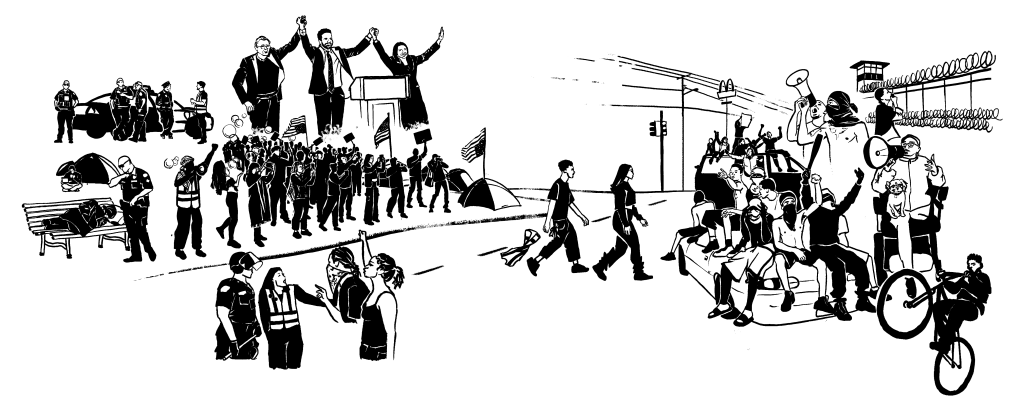
In the United States, millions of people face grinding oppression from the capitalist system, and we’re not doing enough to try to stop it. People regularly hit up Dare to Struggle testifying to this oppression. Here’s one recent anecdote from a public housing resident in New York City:
I’m dealing with the NYCHA situation right now and don’t know what to do I have court next month to see if I get evicted. I have a lot of things that needs to be fixed in the house and my mom is on disability. My grandparents passed on this apartment to me and they lived here in this apartment for over 40 years. I just don’t know what to do anymore and I’m worried that my mom will be homeless. I feel like every road is closing on me when I try everything it’s like nothing ever works out.
Amidst these daily brutalities and indignities, thousands of people engage in some form of activism every week, taking up just causes like protesting ICE or speaking out against predatory landlords. Leftist activism runs the gamut of passing out free food and clothes, hosting events, discoursing on social media, campaigning for politicians and legislation, and holding protests.
The majority of people joining activist efforts and trying to do something about injustices are well-intentioned, in contrast to the people shamelessly trying to make a career or a name for themselves. So what’s the issue? Why is Dare to Struggle often leveling criticism broadly at the Left in the US?
If we’re being honest and facing the facts, we need to acknowledge how the US Left has failed for decades to pose a serious threat to the ruling class responsible for all oppression. We don’t partake in “fascism is here and society is about to collapse” type of hysteria, but there’s no ignoring how awful things are in every direction we look. The vast majority of capitalism’s foot soldiers who brutalize, assault, torture, and kidnap—and the rich and powerful who toy around with peoples’ lives—all go about their days without ever facing any consequences for what they put people through. Leftist protests, meetings, events, etc. don’t threaten the people in power, and they’ve shown no signs of being capable of that. Any argument to the contrary is just coping.
The Left does not take seriously that the stakes are life and death. Poverty is a death sentence in this country. White supremacy and patriarchy concentrate the most horrific violence that people face. We should feel some real responsibility as people trying to overturn the whole social order of our society, and we should subject our political strategies to some actual criticism and reflection as part of that responsibility. Instead of feeling some semblance of responsibility, Leftists treat activism as a social scene, as a way to feel good about themselves, or as a job opportunity.
In our view, to uncritically rock with the Left is to betray the masses. To take a rosy view of the sum total of Leftist organizing is to make peace with the status quo. To stick to aimless strategies for years at a time is to be content with failure. To jump from one pet cause to another, depending on what’s trendy, is to reject having any long-term commitments to different groups of oppressed people. To never critically assess why your collective efforts are leading nowhere is to give up on winning anything meaningful. And to keep scrolling on social media past story after story of what this wretched society is putting people through, and to change nothing about how you’re trying to fight it, is to capitulate, over and over again. We can’t let that go on.
We‘re not putting effort into improving or positively influencing the Left. We’ve seen how turning inward to focus on meeting with other organizations pulls us away from leading actual struggles. We’ve also found that the deeper someone is influenced by Leftist ideology and experiences, the more hostile they are to our organization’s mission of going to the masses (read more about what we mean by “going to the masses” as a political strategy). So we’re not really trying to transform uninspired and toothless Leftist organizations into something better—we’re challenging the people tired of them to leave them. And we’re challenging people to recognize that ditching the Leftist scene and committing yourself to the masses is how we can start to pull ourselves out of the present nightmare.
How did we get here?
We can trace the development of the Left’s lousy politics of today back to the 1970s and ’80s. As the late-60s generation of radicals got busy dealing blows to US imperialism, the ruling class fought back with a vengeance. This included brutal repression of revolutionary organizations like the Black Panthers, the Young Lords, and the American Indian Movement—repression that still looms large over people’s psyche when we talk about fighting white supremacy and capitalism. Mass incarceration was the ruling class’s weapon of choice for dealing with the threat of mass rebellion, which they launched in tandem with flooding city streets with drugs and beginning to roll back social services.
But a more subtle phenomenon that bolstered the ruling class’s counterinsurgency following the late-60s upsurge was the increasing dominance of nonprofit and academic professionals in progressive and radical politics. Nearly two decades ago, the authors of The Revolution Will Not Be Funded documented the creation of the “nonprofit industrial complex,” showing how the number of charitable organizations in the US ballooned from 50,000 in the 1950s to over 830,000 by 2007. Today, there are over 12.5 million people employed in the nonprofit sector, along with over 4 million people working in universities. The salaries for these professionals—policy analysts, nonprofit program managers, social workers, and professors—originate from government and private funding, which breeds conservatism and a religious zeal for reforms rather than revolutionary transformation of our society.
The long-term sellout of radical politics is perhaps best symbolized in the crop of late-60s activists who didn’t just give up on revolution, but also traded their organizing credentials for careers at universities and as politicians. Take Tom Hayden, who was a leader in Students for a Democratic Society and one of the “Chicago Seven” who stood trial for protesting the 1968 Democratic National Convention against the United States’ genocidal war in Vietnam and Cambodia. By 1976, Hayden was running for US Senate, and he went on to hold office in the California State Assembly and State Senate through the ’80s and ’90s. There were others in Hayden’s generation who made soft landings with cushy jobs, in contrast to the steadfast radicals who served decades-long prison sentences.
Fast-forward to today, and the lineage to political elders with real experience leading mass struggles has severely atrophied. Now, protesting genocide is about as eventful as going to the mall. A cliquey culture hovers above activist “spaces” with unwritten norms and ways of speaking that are deeply alienating to the masses. Who we refer to as Leftists are the enthusiastic leaders and participants in organizations that divert radically-minded people into dead ends, training them in ways of thinking and acting that present a radical facade without any substantive action to back it. To the extent there are Leftists taking their politics beyond social media posting, let’s assess how they serve the status quo.
What are the dominant political strategies among the Left? Why are they bankrupt?
Tenant Organizing
From large to small towns, Leftist groups organize meetings with tenants who face evictions, harassment, and neglect from landlords. Landlord abuse and inhumane living conditions are rampant throughout the US, so there’s a deep well of frustration and indignation to draw from. After knocking on doors and organizing some meetings, the more persistent tenant organizers establish tenant unions focused on “building tenant power.” At their best, these efforts involve some documentation of abuse and lead to confronting the landlord or property manager that is responsible. Most tenant organizing never gets this far, but that doesn’t stop organizations from making grandiose claims of fighting for revolution or radical change, only to lower their horizons and close up shop within a few years.
Confronting landlords with the masses is a good thing, but this set of tactics gets mired in a shortsighted local focus when people fixate on small-time landlords and not the broader forces of gentrification and displacement. The bigger games in town, like Democratic Socialists of America (DSA) and the Party for Socialism and Liberation (PSL), completely sidestep going to tenants to actually talk and meet with them, unless it’s for some flicks for social media. They choose instead to get bogged down in lobbying city councils for legislation, an arena that lends itself to constant defeat and rare, but still meaningless, victories. This absolves them of doing any painstaking work to bring people into political battles against the domination of real estate companies.
What all of these tenant organizing efforts share is a narrow focus on material issues, like rent, disrepair, and evictions, without ever elevating peoples’ understanding of the root of their oppression and the mass movements needed to put an end of it. They relate to people solely as “tenants” (notice how much they use the label), while ignoring the other forms of oppression they face, including police brutality, patriarchal violence, the criminalization of youth, and lack of economic prospects. Tenant organizers often focus on their own buildings that they live in, rather than going to the worst slumlords in their towns and cities to fight the worst conditions and treatment that the masses face, all of which they justify with an insistence on organizing “my community.”
Among the country’s largest tenant unions boasting thousands of members, this nominal membership hasn’t translated to posing any threat to the scourge of real estate development and the impunity of slumlords. While we definitely need eviction defenses against predatory landlords, there’s an anti-displacement offensive needed against real estate and the lawmakers backing them, a strategic view we’ve yet to see emerge among Leftists focusing on tenant organizing who wring their hands about things getting worse without coming up with a strategy to stop it.
Labor Organizing
Much like tenant organizing, attempts at labor organizing in workplaces share a narrow focus on material and economic demands. Without politicizing people in these workplaces to fight for radical changes beyond their own personal economic interests, labor organizers confine their struggles to carving off a bigger share of the loot from murderous, destructive billion-dollar American companies.
Leftist labor organizers throw around excuses for the lack of meaningful wins and the continued erosion of “labor power” across the US. The 1947 Taft-Hartley Act prohibited “solidarity strikes” directed in support of other causes, marking the beginning of a long decline in the size and militancy of strikes. 100+ year-old crusty labor unions like SEIU and Teamsters wield massive political influence, often subsuming smaller, more radical-in-rhetoric labor organizing efforts under their control. But this only happens with the willing participation of the supposedly more radical Leftists who initiate unionization efforts, only to swap their ideals for the “practicality” of working with and within business unions. Just as fruitless are the calls to initiate a general strike across industries throughout the US, an idea we’ve yet to see materialize despite all the bloviating about it on social media and in DSA meetings.
Among the Left, a blanket lionization of “workers” and the working class obscures the stark differences in loyalty to US imperialism and the exploitation endured among the millions of people who the Left lumps together into one big workers category. For our purposes, what matters more is uniting with all the sections of US society who want to take a stand against the system and its daily brutalities, whether that necessitates going to the masses in workplaces or elsewhere.
Mutual Aid
Every Saturday around the country, Leftists show up for a “distro” operation at parks and community centers. Organizers pass out free food to people facing homelessness and poverty. The political strategy boils down to how the masses have unmet “survival needs,” so giving people free food helps with that. What distinguishes Leftist mutual aid from food pantries and soup kitchens is unclear to us: there are people serving and receiving food, there’s some small talk, and the crises of hunger and homelessness are left intact.
A different example of mutual aid we heard of recently involved raising money to allow immigrant vendors to stay home in the midst of ICE raids ramping up. Another was a group of activists stepping in to help homeless people move their belongings before sanitation and police departments organized sweeps to terrorize them. These kinds of efforts reinforce passivity among the masses, instilling a sense that we have to accept the system’s brutalities and consign our efforts to softening the blow, rather than standing together to actually try to stop this all from happening.
At the onset of the pandemic in 2020, millions of dollars flowed into mutual aid organizations. We’re not here to criticize how this money went to people in dire straits. We’ve organized fundraisers ourselves to support people who have piling bills after their loved ones were murdered by the police, or legal fees for their deportation case, or hospital expenses after getting injured at a protest. What we think matters is how we relate to people receiving support. Aid should be in service of helping people lead and participate in the collective struggles needed to rid our society of hunger, medical debt, and back rent, not just for “survival needs” and coping with the current state of things. And since it needs to be said, we should offer support alongside a real effort to develop personal and political relationships with people, not just to hand shit out to feel like we’ve done a good deed.
Electoral Politics
Perhaps the most unserious and self-serving strain of Leftist political work involves trying to get “progressive” and “socialist” Democrats elected to Congress or in local government. Tens of millions of dollars have funneled into campaigns to elect and re-elect Democrats who supposedly buck the party line of linking arms with Republicans to oversee the US government death machine. The electoral circus would be easier for us to write off if it didn’t come with so much fanfare.
The naive support for slick-talking Democrats took off with Bernie Sanders’s unexpected success in the 2016 Democratic primary against Hilary Clinton. Since then, prominent Democrats like Alexandria Ocasio-Cortez, Ilhan Omar, Rashida Tlaib—and now Zohran Mamdani—have reached sainthood status in the hearts of many Leftists around the country. Some like AOC have traded fiery rhetoric for jockeying to become heirs to the party throne, dutifully cozying up to ghouls like Nancy Pelosi and Chuck Schumer, waiting in the wings for the day they retire or keel over. Others like Jamaal Bowman and Cori Bush were unceremoniously cast out by the Democratic Party after short tenures. In more fringe pockets are third-party candidates from groups like the Green Party who treat elections as publicity grabs, along with clowns like Claudia and Karina from PSL who parade around in recruitment drives for their organization.
In 2016, the DSA blessed us with this sharp, far-sighted analysis of where electoral politics stood after Bernie’s defeat: “2016 was a game changing year for leftists and progressives. We are finally reemerging as a vital and powerful force after an extended period of stagnation and demoralization, and we face a political landscape more favorable than perhaps at any time since the 1960s.” For the Leftists who have finessed careers and social media followings off of Democrats like Bernie and AOC and Zohran, the political landscape certainly proved favorable for them.
For the masses in the US who confront police brutality, crumbling apartments, homelessness, drug addiction, unemployment, and more, what have Democrats like Bernie and AOC done for them? Nothing. For the Palestinian masses in Gaza whose families were annihilated by US-made bombs, what have Democrats like Ilhan Omar done for them? Nothing.
Internet Maoism
As niche online subcultures have proliferated, an unfortunate one to gain a lot of traction in recent years is what we call “internet Maoism.” This trend is concentrated among high school and college students who have an impressive amount of arrogance for people who have never led a protest among the masses. Their main thing is posturing online by quoting Lenin like Bible verses, saluting the immortal contributions of supreme leader Chairman Gonzalo, and blurring their faces (and shoes!) in every social media post.
There’s more to say to make fun of all this, but jokes aside it makes us sad and angry to see rebellious young people have their brains filled with worms from Instagram and Discord servers. Our suggestions to anyone caught up in the internet Maoist milieu are to delete your social media, get a flip phone, and get a job at a bakery or a laundromat where you’re forced to interact with people in the real world.
Abolition
Lastly, we have to address the idea of police and prison abolition. With the rise of Black Lives Matter, an organization that seized on mass rebellions in Ferguson, Baltimore, Minneapolis, and other cities from 2014 and beyond, abolition became an unquestioned dogma among the US Left.
Abolitionists claim to be fighting for a society without prisons and police. To be sure, these institutions are responsible for some of the most horrific violence and depraved human behavior in the history of capitalist society, and they would cease to exist in their current form in a more just, compassionate society. From that conclusion, we see it as necessary for us to initiate struggles among the millions of people who are currently and formerly locked up, along with those living under the gun of police brutality in their neighborhoods. But for abolitionists, a critical view of police and prisons doesn’t go beyond discourse. This discourse includes an array of reactionary ideas, like the insistence that we shouldn’t demand killer cops be thrown in prison, something that is universally demanded among families who have had a loved one killed by police. There’s also the fixation on the existence of “carceral” institutions that regulate and punish socially-harmful behavior, refusing any consideration for how these institutions led by the masses, not the police, could be wielded for public good.
The political program of abolition—a strategy attempting to answer how we abolish these institutions—doesn’t exist. Abolitionist political work among the masses is about as nonexistent. But you can read a lot of books and listen to a lot of podcasts about the “framework” and “horizon” of abolition that we can meditate on in our communities of collective care and restorative healing (we need to make fun of how strange these people talk). We’ve searched far and wide for abolitionist organizations that are leading serious, sustained work among the masses to fight mass incarceration and police brutality beyond the confines of reforms and beyond the grifts of nonprofit and activist careers. We haven’t turned up any.
Among some so-called abolitionist organizations, Leftists hold sporadic efforts to write letters and send books to people locked up in prisons and jails. We’ve been doing more of this ourselves recently and see lots of value in it, but only when we’re doing it in tandem with actually trying to fight injustices from inside and outside prisons. This can include organizing protests, confronting prison officials, working with families whose loved ones are locked up, and building ties with people inside who are making trouble for their oppressors. We don’t see anything resembling this among the the abolition crowd. We’ll start taking them more seriously if they ever stop taking cues from Mariame Kaba, the best-selling abolitionist author, and start moving more like Harriet Tubman, a real abolitionist who fought white supremacy in a way that today’s Leftists can’t fathom.
Don’t you want to unite all who can be united?
Taking a critical stance against the Left invites criticism, starting with the question of whether we’re alienating potential supporters and allies. If we’re talking about building mass movements, shouldn’t we be trying to draw in as many people as possible? Shouldn’t we try to win over and work with other organizations?
For us, the key question really is: Who can we have political unity with in order to work together? Since we started our organization, we have fought to make “going to the masses” a dividing line between those serious about fighting oppression and those stuck in Leftist oblivion. If we can agree that we need to spend the vast majority of our time dedicated to bringing masses of oppressed people into collective struggle—people who aren’t already part of insular activist scenes—then we can get somewhere in working together as organizations. If individuals joining our work can get behind these core ideas and dedicate consistent time to helping us advance our campaigns, then we can work with them. But way too often, we can’t come to a basic unity on this question. People want to stay in their comfort zones, and they want to stick to their dead-end Leftist strategies. Or people initially agree on paper, then quickly trail off once things get a little difficult (or never try to begin with). If people show in their actions that they don’t really have a heart for the masses and don’t really want to fight alongside them, then we’re not going to waste our time trying to change that for them. There’s no unity to be had.
Many people online have thrown a fit at any whiff of our criticisms of the Left, calling us sectarian, adventurist, and a litany of other dumb shit for having the gall to pose honest questions about why we keep losing and what we have to start doing differently. To those who recoil at Dare to Struggle criticizing what’s not working, we want to ask: Why are you above criticism and scrutiny? Why do you treat all criticism as “sectarian infighting”? Why are you okay with staying powerless against the brutality of the system?
How do I know Dare to Struggle is right about this? Why should I trust you?
The simple answer is you decide for yourself. You can come out to anything Dare to Struggle has organized and see how we carry ourselves. You can hit us up to set up a call and learn more about what we do every week. We ultimately put down these critical views for those who are disillusioned with the US Left but still wrapped up in it. Take this as encouragement that something better and more meaningful exists and is growing, and you should be a part of it.
Drawing this line against the Left leaves us with a bleak assessment of the organized forces that are out there that could lead and coalesce around mass movements that threaten the ruling class’s grip on power. To paraphrase Mao Zedong, who led a revolution with millions of people fighting over the future direction of Chinese society, the failures of the Left in the US aren’t primarily because of external factors, like the strength of the ruling class and all their foot soldiers. It’s because of the unseriousness, lack of coherent strategy, and rampant opportunistic behavior that is the norm from within the Left. Too often we see people treat their political work as a dating pool, as a social clique or friend group, as a way to make some money, and as a way to feel self-righteous without sacrificing any of their personal comforts.
This culture of activism in the US smothers serious efforts among radicals and aspiring revolutionaries, or more often it prevents them from emerging in the first place. As long as this remains the M.O. of Leftist activism, we will need to distance ourselves and delineate us from them. The positive side, though, is that we gain clarity on what we need to do: leave behind the Left and go to the masses, integrate with them, and struggle tooth and nail to bring people along in fighting like hell together.
If you’re part of an organization that you think is making a serious effort to wage collective struggles among the masses, then we want to hear from you. We would love to hear what have been your successes and challenges in leading these struggles and see what we have to learn from each other. As a suggestion, don’t call us “comrade” when you hit us up—let’s set the bar higher for who we consider our comrades. And if all you do is pass around petitions, try to get people elected or bills passed, hand out free food or boring literature, or hold events with the same circle of activist types, then we urge you to start doing something more serious. Cast away your fixations on safety, comfort, and just doing what makes you feel good, since none of this should matter to you when the masses don’t have it for themselves.
If you live in a town or city that doesn’t have a chapter of Dare to Struggle, you should hit us up about starting one. We know it can feel intimidating or daunting, but we will spend time with you week after week to get something off the ground, even if it means traveling to where you live to show you the ropes, or inviting you to spend time with one of our chapters. Dedicating yourself to the masses is one of the most meaningful commitments you can make, as is your life being about others instead of just yourself. We invite you to come find out for yourself.
 Dare to Struggle