THE MYTH OF POLICE ACCOUNTABILITY IN CHICAGO
On November 7, 2024, the Chicago Alliance Against Racial & Political Repression (CAARPR) held a “Day After the Election Rally” in downtown Chicago to protest the incoming Trump presidency. In front of a crowd of hundreds, one of the speakers, CAARPR-backed Police District Councilor Anthony Bryant, declared to the crowd: “Here in Chicago, we did something last year that’s historic and the first of its kind. We have community control of the police!”
Less than two months later, on the evening of January 3rd, 2025, Timothy Glaze, a 57-year-old with cancer, was experiencing a mental health crisis, and his girlfriend called 911. The Chicago Police Department responded to the call by shooting Glaze 28 times, killing him in front of his girlfriend.
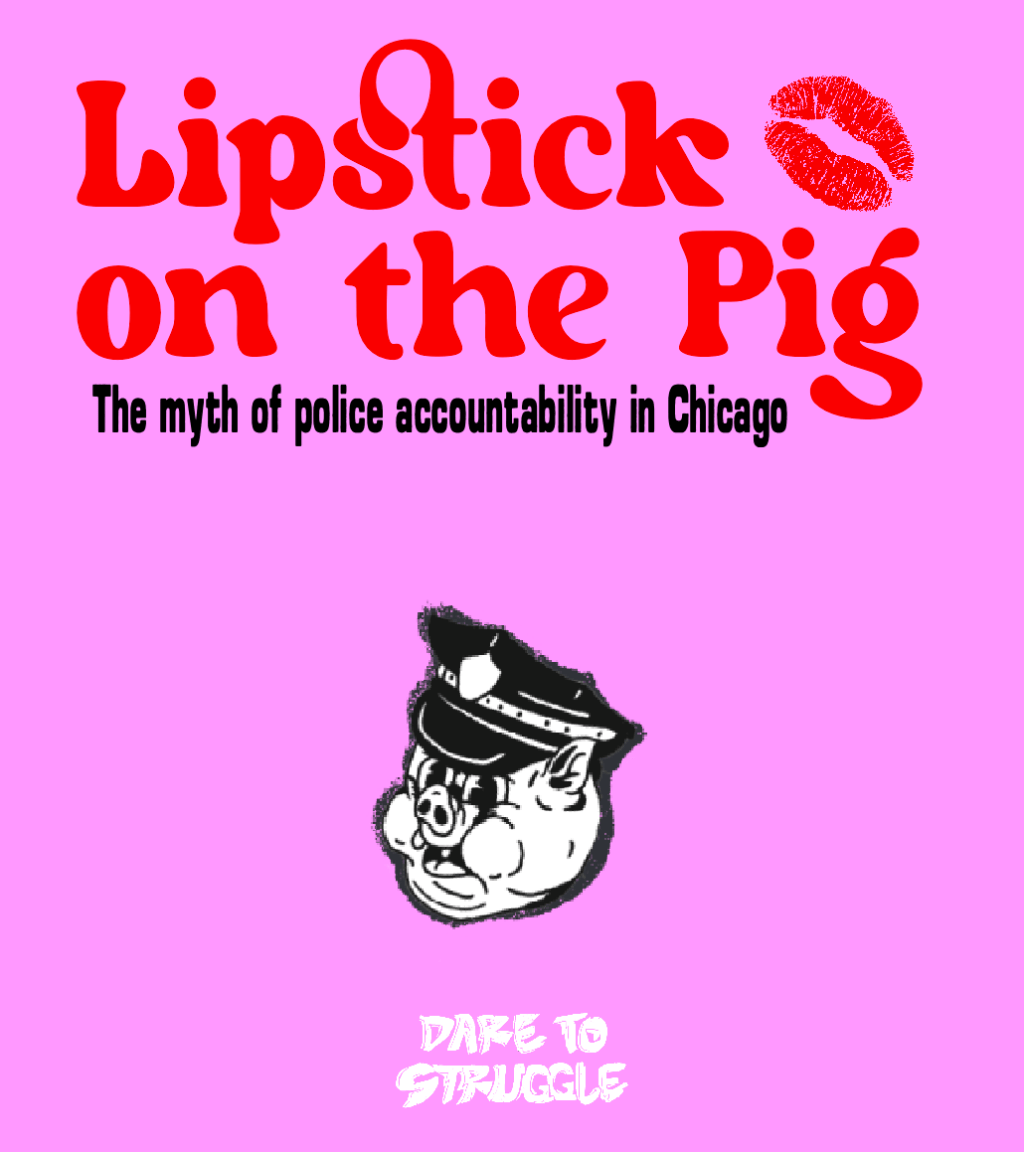
Is it possible that Chicago has “community control of the police,” or as some advocates claim, that it is on the road toward community control, if the police are still murdering people with impunity? For months, Dare to Struggle has been talking to people around Chicago about the realities of living under the boot of the CPD: the family members of people gunned down by the police, the young men on the West Side of Chicago who are routinely stalked and harassed by the police in unmarked cars, and the loved ones of people rotting in Cook County Jail. For those living with the daily brutality and oppression of the CPD, Chicago’s celebrated system of police oversight has done absolutely nothing to hold killer and brutal cops accountable; it’s simply lipstick on a pig.
History
“Be sober-minded; be watchful. Your adversary the devil prowls around like a roaring lion, seeking someone to devour.”
– 1 Peter 5:8
Chicago, like other large cities, has been dangling the promise of police reform before the people for more than 50 years. Beginning in the 1960s, when the CPD was little more than a white supremacist extension of the corrupt Daley machine, police commissioner Orlando Wilson implemented the Internal Investigations Division. Like every other version of police accountability that would follow, this attempt sought to ameliorate and professionalize the police while maintaining their fundamental role in oppression and repression. The CPD of the late ’60s became internationally infamous for the police riot they staged at the 1968 Democratic National Convention, and the 1969 murder of Black Panthers Fred Hampton and Mark Clark, who were shot 80 times.
The ruling class across the country implemented both the carrot and the stick in response to the mass rebellions of the 1960s, murdering and locking up rebels on one hand, and drafting others into the ranks of government, while creating new agencies of oversight and reform. By 1974, even the Chicago Police replaced the Internal Affairs Division with the Office of Professional Standards (OPS), which was supposed to “operate independently.” Under the “independent” eye of the OPS, one of the worst atrocities in the history of U.S. policing took place: the John Burge torture ring. For 19 years, Burge and his “midnight crew” stalked the South Side of Chicago, kidnapping Black boys and young men and subjecting them to torture until they confessed to crimes. This torture included beatings, suffocation, burning, and administering electric shocks to the genitals.
The OPS investigated the years of torture and issued a scathing exposé, the Goldston Report, only for the findings to be covered up for years by then-superintendent Leroy Martin. All the while, the CPD defended Burge in court and argued that the Goldston Report was “unsubstantiated.” By the early 1990s, police accountability had progressed to the point that the OPS could report on the atrocities of the CPD, but with no actual power to prevent them or bring them to an end. It would take another two decades for the Burge victims (including some who were on death row as a result of their torture-induced confessions) to receive a measure of justice, and Burge died without ever being criminally punished for operating a torture ring.
It took years for the full extent of the Burge torture ring to come to light, both because of systematic coverups by the CPD and the second Mayor Daley’s administration, and the ineffectiveness of the OPS. Following a 2006 report that detailed the Burge crimes and cover-up in great detail, the OPS was replaced with the Independent Police Review Authority (IPRA). While IPRA was supposedly more independent (it was even in the name!), it contained many of the same members as the OPS, and rarely recommended discipline against any police officers. IPRA was exposed as another toothless board following the 2014 police murder of 16-year-old Laquan McDonald and the subsequent cover-up, in which IPRA and Mayor Rahm Emanuel withheld the video of McDonald being executed by the police for more than a year.
Alphabet Soup
“The mayor lying, saying he didn’t see the video footage. And everybody wants to know where the truth is.”
– Vic Mensa
In the wake of the 2014 Ferguson uprising and ahead of the 2015 mayoral election, the CPD, IPRA, and Rahm Emanuel attempted to keep the video footage of the police killing of McDonald from public view. The court-ordered release of the footage sparked a series of major protests and created a widespread loss of legitimacy for the CPD and any attempts at reform or accountability. The combination of disruptive protests and the potential for mass rebellion, expressed by the Ferguson and 2015 Baltimore uprisings, posed a real challenge for the rulers of Chicago.
It was in response to the protests, fear of uprising, and loss of legitimacy that the city of Chicago turned to the alphabet soup of police oversight agencies that people must navigate today. In 2017, IPRA was dissolved in favor of COPA, the Civilian Office of Police Accountability. Like all previous bodies, COPA is made up of people who are expected to work closely with the CPD, and its chief administrator is always appointed by the Mayor of Chicago, who also oversees the CPD. Even with “more” independence and civilian oversight, COPA is not empowered to fire or discipline the cops who routinely kill and brutalize, only to make recommendations to the mayor, police superintendent, and city council.
Following the 2020 uprisings and continued egregious CPD killings, such as the 2021 police murder of 13-year-old Adam Toledo, Mayor Lori Lightfoot worked overtime to rebuild public trust in the CPD by creating another toothless alphabet soup agency. Lightfoot negotiated a compromise with various activists for police reform, including the supposedly pragmatic Grassroots Alliance for Police Accountability (GAPA) and the allegedly radical Chicago Alliance Against Racism and Political Repression (CAARPR). CAARPR had, for decades, championed an electoral path to an undefined “community control of the police” and had a lineup of longtime opportunist operators meeting with Lightfoot to hammer out the details.
What resulted from those negotiations were two new alphabet soup bodies, still powerless to hold the police accountable. The Lightfoot-police reformer alliance created a series of 22 elected police district councils, which are only empowered to hold meetings and make recommendations, and the Community Commission for Public Safety and Accountability (CCPSA), which holds hearings and makes recommendations to the mayor, including hiring recommendations for the head of COPA, the police board, and the police superintendent. Advocates for this mind-boggling system claim that, despite the powerlessness of these bodies, they represent something positive because the people who staff them are elected, not appointed by the mayor (who is, of course, elected). All that they have done is create another set of bodies to hold endless meetings that, by definition, cannot deliver justice to the people who encounter them.
The only body with the power to actually discipline the police is the 9-member Police Board, whose members are appointed by the mayor. This body, historically and currently pro-police, can only act to discipline cops on the recommendation of the superintendent.
The Cold Truth
“I’m for the truth, no matter who tells it.”
– Malcolm X
The cold truth of the dizzying array of police accountability bodies is that no matter how many the city creates, they are fundamentally no different from the failed bodies that came before them. People come to these bodies hoping for some measure of justice, some measure of accountability after experiencing unspeakable tragedy. What they are met with is empty rhetoric and false promises. The reality is that COPA, CCPSA, and the rest of the alphabet soup agencies aren’t an escape from police oppression—they serve to reinforce it.
Some of the people who have promoted these failed solutions over the years were well-intentioned reformers. By now, though, it should be abundantly clear that constantly inventing new, toothless police reform boards will not deliver justice or accountability to the people. So why do people persist in advocating for these non-solutions?
- In the last decade, police reform has become big business. While the families of victims of police murder often scrape by, resorting to crowdfunding to bury their loved ones, a few people like the founders of “Black Lives Matter” have gotten rich off the misfortune of the masses. In Chicago, phony police accountability solutions like the CCPSA have been promoted by individuals and organizations who have written books, made careers, and built social capital promoting the lie of “community control of the police.” Groups like CAARPR, who promise radical-sounding but ultimately non-threatening reforms, have brought in big money from foundations and individuals, and their members can secure jobs with politicians or on the police district council. We call these people—who make their careers benefiting from police oppression—grifters, and they can’t be trusted.
- The ruling class and those who serve their interests have figured out that small-scale reforms are an effective way to neuter opposition and keep it from actually challenging the racist cops and the system they uphold. They can make promises that fool some people (“this reform will be different”) or change the faces of the people running the agencies or serving as mayors or police chiefs. And when they implement reforms like COPA and CCPSA, they bring their one-time opponents into the system. In Chicago, the CCPSA head is Anthony Driver, a union activist. Driver was one of the biggest advocates for current CPD superintendent Larry Snelling, recommending him to the mayor and giving Snelling, the chief pig of Chicago, the personal stamp of approval from a police reform board whose advocates claimed they had won a big victory.
A Question of Power
“You have to understand that people have to pay the price for peace. If you dare to struggle, you dare to win. If you dare not to struggle, then goddamn it, you don’t deserve to win. Let me say peace to you, if you’re willing to fight for it.”
– Fred Hampton
For more than 50 years—from the Daley machine to John Burge to today—the CPD has hunted the streets, kidnapping, beating, and torturing with near impunity. Protesters have been brutalized, and hundreds, if not thousands, of lives have been stolen. The reason these killer cops have not been brought to heel is not because no one knows how to run the police department better, and especially not because Chicago is lacking in oversight bodies.
The police in the U.S., with their powerful unions and culture of impunity, exist to repress dissent and exercise social control over the sections of the population that are most potentially threatening: Black, Latino, Indigenous people and members of the proletariat. As long as various reformist schemes don’t address that reality, they will remain fundamentally cosmetic.
The police have tremendous power. They can kill and get away with it—and they have been for generations. But the masses of people, especially those most under the gun of police brutality and oppression, have more potential power. That potential power was on display in the upsurges of the 1960s, in the bold actions of the Black Panthers and the Young Lords. It was on display in the mass rebellions against police killings that rocked the country in 1992, 2014, and 2020. Its potential was shown in the annual protests against police brutality that occurred on October 22nd for years, and were relaunched in 2024 by Dare to Struggle.
In Dare to Struggle, we’re working every day to bring forward those under the gun as leaders in the movement to actually end police brutality and murder and to get justice for the victims and their families by sending killer cops to jail. Part of that process is exposing the lie that these police reforms are something more than lipstick on a pig. We aren’t interested in makeovers, we are interested in fighting back. You in?
Printable pamphlet PDF below, recommended settings: double sided and “flip on short edge.”
 Dare to Struggle