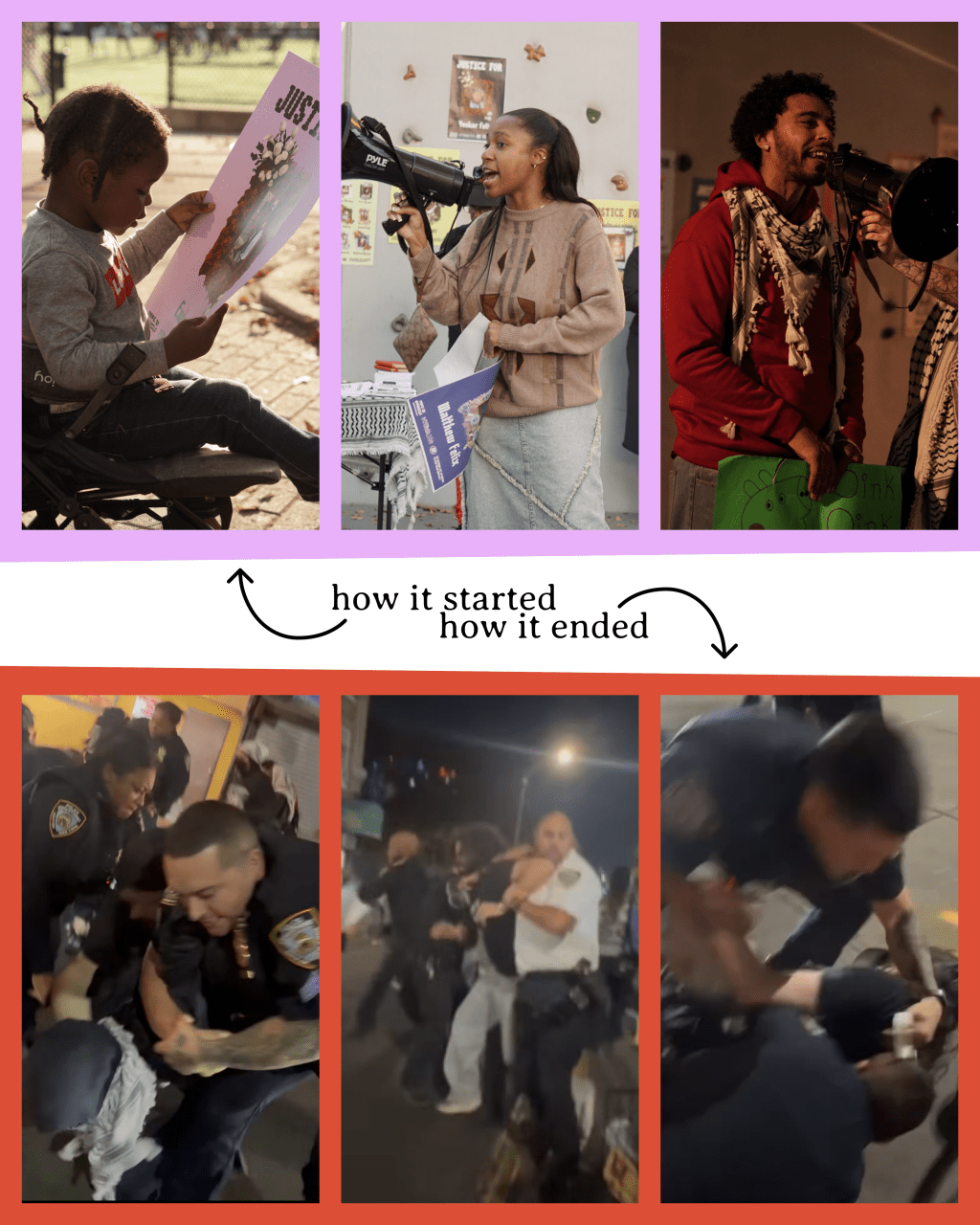
At a court appearance in November, four people, including three members of Dare to Struggle, refused to take deals from a judge after we were arrested in Brownsville, Brooklyn on the October 22nd National Day of Protest Against Police Brutality. That evening, we were protesting outside the NYPD’s 73rd precinct, which has a long rap sheet of brutalizing Brownsville residents, including the September 15 subway shooting that left Derrell Mickles, Gregory Delpeche, and Kerry Gahalal severely wounded.
In waging struggles to confront murderous police departments, we view repression as inevitable. We also view prioritizing our own safety as a futile endeavor, strategically, to win demands like jailing killer cops as punishment for their crimes. It’s also selfish, since for the people of Brownsville living under the 73rd precinct, it’s never safe to walk down the street, sit in their cars, ride the subways, or buy a meal in a bodega.
Historically, radicals and revolutionaries in the US have made advances in the face of repression by meeting repression with more resistance (look up the case of Angelo Herndon for an example). In order to build mass movements against police brutality and other injustices, we need to learn from these historical lessons by fighting repression to strengthen our movements and win political battles, rather than accept uncritically that backing down in service of our “safety” is what’s best.
This view informed the decision of four of us arrested on October 22 to refuse to take a deal that a judge offered us, called an adjournment in contemplation of dismissal (ACD). An ACD deal results in a dismissal of charges as long as the person arrested doesn’t get arrested again for a period of time (usually three to six months). ACDs are a key feature of the court’s approach to handling mass arrests, and judges have likely given out hundreds of these deals in New York following mass arrests at pro-Palestine protests in the past year. Courts have been inconsistent in enforcing the ACD “stay out of trouble” stipulation, so a perception has grown among protesters that it’s safe to collect multiple ACD deals, and that they are effectively a non-consequence.
The principal problem with taking deals like ACDs and not fighting politicized charges more generally is that this allows the police to systematically beat and arrest people at protests, then keep those arrested from coming together to expose the brutality and unjust treatment they endured. It has also led to protesters viewing ACD deals as acceptable outcomes for protests, which lawyers reinforce, and dampens outrage directed at unjust and violent arrests because of the perceived lack of consequences. Taking a deal also lets the pigs off from getting their lazy asses to the courtroom.
This is part of a broader lack of a coherent strategy of collective resistance to repression, instead electing to take individualized approaches. It is in essence playing by the bourgeois state’s rules and counting on them to maintain the arrangement of letting people stack ACD deals, which we see as a questionable legal strategy. These are missed opportunities to face repression with defiance and uphold our righteous stands against injustices. While the four of us who refused to take an ACD are not facing serious charges, we nevertheless think it’s right to make a stink out of the fact that the police attacked our constitutional right to protest and refuse a plea deal that normalizes police repression of protest.
All this isn’t to say that taking an ACD or a plea deal for a more serious charge is never the right move. We need to maintain our ability to be in the streets and develop organization among the masses, and as Mao Zedong put it, “we should do our best to avoid unnecessary sacrifices.” But the current situation— where lawyers and Leftist “safety” culture steer people arrested from publicly fighting charges—needs to change.
There are numerous examples from the past year of pro-Palestine protesters pleading not guilty to bullshit charges designed to intimidate them into silence, including from campus protests at Arizona State University, Harvard, University of Florida, and Tulane. In November, in response to protest arrests at Cornell University, about 200 supporters packed a courtroom for a hearing in which three graduate students pleaded not guilty to disorderly conduct charges, as reported by the Cornell Daily Sun. These protesters were part of a group that clashed with police in September at a career fair on campus that welcomed defense contractors Boeing and L3Harris. Also in September, eight people arrested at a student encampment at the City College of New York pleaded not guilty to burglary felony charges, as reported by the Columbia Spectator. In a statement, one protester said: “We believe that challenging these charges is a necessary stand against the unjust system that seeks to silence dissent and criminalize resistance.”
Fighting charges from mass arrest events is a chance to take a courageous stand, collectively, in the face of threats of punishment. It’s also an opportunity to continue exposing the vicious and militarized police assaults against protest movements, like the April 30 attack on protesters at encampments at City College and Columbia, where hundreds of police officers made 282 arrests between the two campuses. In our case, talking to people in Brownsville about our experience getting arrested on October 22 has led to hearing peoples’ own testimonies of violence and mistreatment from the 73rd precinct, a small but crucial step in building our forces to fight back against police brutality in the neighborhood.
Regardless of the outcomes of our upcoming trials and those with higher legal stakes, it will always be right to rebel rather than to stay silent. The masses living under the gun of police brutality in the US, and the masses of Gaza now entering year two of genocide, are given no choice to escape bullets, prisons, and for Palestinians living in Gaza, the imminent threat of annihilation. After experiencing just an inkling of what the people of Brownsville endure from the 73rd precinct every week, we think it would be a mistake to retreat to safety. And as we noted in our previous statement on fighting repression, we have a responsibility to demonstrate to the masses that we can fight back against the ruling class’s repressive forces, and that we can reach a point in the struggle where they can no longer brutalize and murder with impunity.
 Dare to Struggle