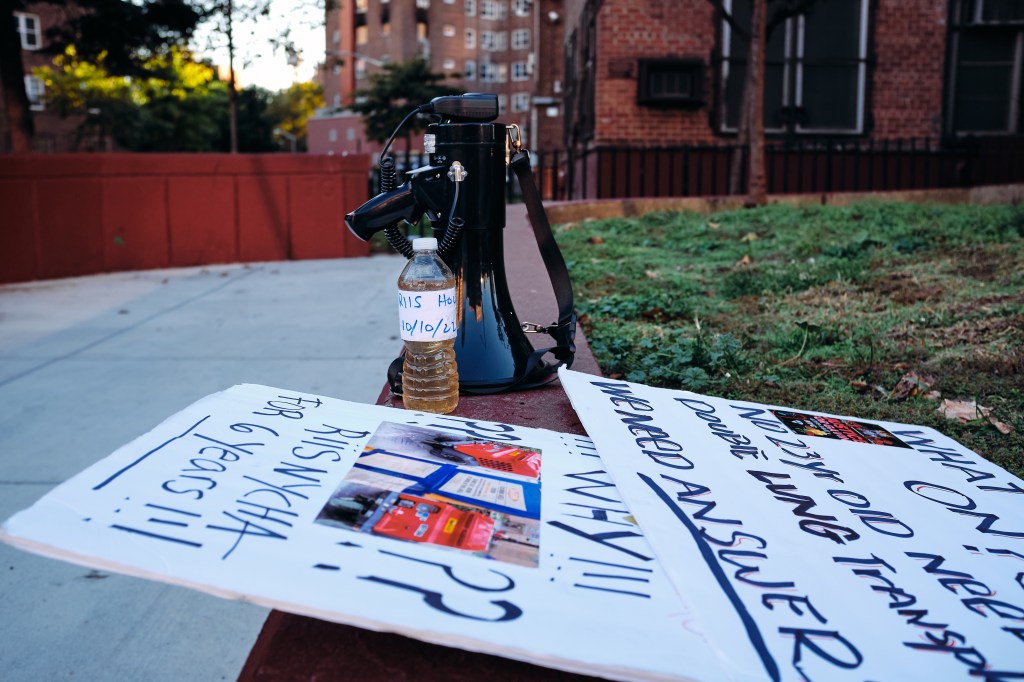
In September 2022, Dare to Struggle responded to a scandal in the Jacob Riis housing projects in the Lower East Side of Manhattan when arsenic was detected in the water at the development after people had reported getting sick and rashes from the water for weeks. We organized two protests, multiple mass meetings, and helped residents confront city officials. Together with residents, we organized a People’s Tribunal, a day meant to put city officials and the New York City Housing Authority (NYCHA) on trial and indict them for criminal neglect of the people living in public housing. The residents of Jacob Riis Houses, with the help of Dare to Struggle, have come together to form an organization, Rogue Residents – Jacob Riis, a fighting organization of tenants who want to take on NYCHA and the city to stop the displacement of people living in public housing through collective struggle.
Through a concerted effort, the government has defunded public housing, which is causing apartments and entire buildings to go without much needed repairs for months and years. They created the problem and are using it as an excuse to privatize. Their “solution” is to put NYCHA buildings under the management of private developers who have the power to evict people. Tens of thousands of people all over the country have been displaced by the privatization of public housing. But there are more than 400,000 people living in the projects in NYC who can be mobilized in mass resistance to stop the privatization of NYCHA, demand that NYCHA do the repairs, and refuse to let any residents be displaced.
Dare to Struggle was formed in the Fall of 2021 and has been waging a campaign against the privatization and disrepair of public housing in New York City. We don’t rely on the politicians, we rely on the people subjected to these conditions, mobilizing them to take mass action. Our political work at Jacob Riis Houses was the culmination of over a year of social investigation, planning, and learning from the people that started at the Queensbridge Houses, the biggest public housing development in the country. Reflecting on the events of the last year, we have identified the mistakes and limitations of our work and are making new plans and seeing new opportunities to win political battles in the struggles ahead. This summation is for those who want to fight the American nightmare together with conviction, heart and strategy. There is a dire need for organization, struggle, and summation, so we hope this can both set an example and be the start of a dialogue for anyone serious about fighting and winning.
Background: Queensbridge, Investigation, and Lessons Learned
We started by talking to people in the Queensbridge Houses about what they were up against to organize them in collective struggle. We were conducting our political work in Queensbridge for a year based on the accounts of crumbling conditions and neglect of buildings from people who spoke with us. Our aim was that by going door to door, we could start bringing residents together, host meetings on a regular basis, and organize speak-outs and protests in the projects. Our agitation was strong, “NYCHA is letting public housing fall apart because they want to get rid of it! NYCHA is the biggest slumlord in New York!”. From the masses, we learned about the decrepit conditions in public housing and how we can fight, and we have been transmitting what we’re learning back to them in the form of periodic bulletins that promote meetings and protests, contain news and information about developments in the struggle, and address the questions of the masses.
From going to the masses, we ran into some contradictions that we’ve had to contend with:
- NYCHA has waged its own campaign to convince people that privatization is the solution to their problems. They hold sham meetings that give the illusion that residents have a say in how that privatization will be carried out. NYCHA has the power, time, and resources to spread this information, sending propaganda straight to residents, giving themselves a cover for the dispossession being carried out.
- The politicians, nonprofit organizations, and tenants associations active in the projects divert people from collective struggle. They do this in several ways:
- Politicians come around and make promises to get votes. These politicians are either pushing for privatization or doing nothing to actually stop it. They give the impression that something is already being done to deal with the problems in public housing.
- Some nonprofits that are set up to provide job programs, charity, and other assistance, that also claim to be advocacy groups, are funded by the city and partner with politicians. At best, they don’t have a grasp on what’s going on and don’t mobilize people to fight. At worst, they divert people to submit their grievances to the “official channels” that don’t work.
- The tenants associations play the role of being liaisons between NYCHA officials and public housing residents. They are composed of residents who are up against the same things that everyone else living in NYCHA has to deal with, but there is a failure on their part to see the need to mobilize resistance. Although many residents join the TA to do good for other residents, they are not organizations that fight for the people, and the TA is too tied with NYCHA to make change (they get funding for their programs from NYCHA). Their leadership often preoccupy themselves with food distribution programs that are rife with favoritism.
- Ultimately the politicians, nonprofits, and tenants associations train people to leave it to them to negotiate with NYCHA and the city, instead of mobilizing residents as a fighting force. The leadership of nonprofits and tenant associations often oppose mass mobilization. Residents are then disillusioned by politics and organizations since what’s out there never addresses fundamental problems or delivers on their needs and ambitions. This prevents some people from seeing the need to get organized.
- There are also objective conditions that prevent people from getting involved, such as disability, health issues, poverty, the need for childcare, and fear of retaliation for speaking out. Since NYCHA and the NYPD have a close working relationship, some people are afraid that taking political action can also lead to trouble with the police.
There were three weaknesses to our work in Queensbridge:
- Pitching our efforts to the intermediate
Mao Zedong, the leader of the Chinese Revolution, wrote that “the masses in any given place are generally composed of three parts, the relatively active, the intermediate and the relatively backward. The leaders must therefore be skilled in uniting the small number of active elements around the leadership and must rely on them to raise the level of the intermediate elements and to win over the backward elements”. “Some Questions Concerning Methods of Leadership” (June 1, 1943), Selected Works, Vol. III. p. 118.
In Queensbridge, we had the tendency to pitch things to intermediate sections of the people. We were struggling with residents over questions of whether people will want to fight, rather than focusing on the people who wanted to fight in the first place. Some of the more advanced residents were frustrated by this, and we were unable to consolidate organization among residents. - Hesitation to take up leadership. While it is correct and necessary to rely on the masses, the masses are looking for real leadership when faced with politicians, nonprofits, and tenants associations that lead them astray. We were objectively leading things but downplaying our leading role by being hesitant to struggle over incorrect ideas and insufficiently raising the political consciousness of the advanced (as mentioned above). Our leadership wasn’t strong enough, so residents weren’t taking up leadership themselves.
- Capacity and inexperience. Dare to Struggle is a small organization with a handful of dedicated members who are learning through practice. We are looking to grow, but until this point there haven’t been enough dedicated members to carry out the full breadth of the work needed.
Intervention in the Jacob Riis Houses Water Crisis
The projects are a site of gross neglect with rat and roach infestations, busted pipes and decaying walls, as well as mold and asbestos. These are chronic issues that a significant number of people have to deal with. Queensbridge is no exception. However, in the absence of a dire crisis that affects everyone in a development, like the water crisis in Jacob Riis Houses, the urgency around taking action was also missing. The crisis in Jacob Riis Houses thus presented an opportunity to mobilize people who were dealing with a severe situation.
By the time the news broke out of arsenic detected in the water at Jacob Riis Houses, we had experience from our work in Queensbridge and aimed to apply what we learned. We responded quickly and attended a big meeting for Riis residents on September 9th at PS 34 where city officials and NYCHA CEO Greg Russ came to proclaim that the positive arsenic test result was false and that the water was safe to drink and had been safe all along. We were four people, two inside the meeting and two outside, passing out flyers and agitating to crowds of people. The room erupted in protest, with people shouting down Greg Russ and city officials and demanding real answers, not a cover-up. Residents of Jacob Riis Houses had been getting sick and getting rashes from the water for weeks, and knew something was wrong with the water. Meanwhile, outside the meeting, all the residents who weren’t allowed inside due to room capacity were also protesting. We didn’t cause the uproar but we strengthened its political character through the exposure of Greg Russ and NYCHA in our agitation and flyering, and by connecting the Riis crisis to the privatization and disrepair across the city.
70 people signed up on our contact list and we set up a meeting with residents the next day to organize a protest in Riis within the week. Dare to Struggle and Riis residents arrived at these demands together:
- Independent and Fully Transparent Testing NOW!
- Fix the Water and the Lack of Gas at Jacob Riis!
- Fire Greg Russ!
- No NYCHA Privatization!
1st Protest: September 14th 2022
On September 14th, about 35 people gathered in front of the management offices of Jacob Riis Houses and marched through the projects. Residents spoke out on the mic to expose what they have been going through. On September 15th, it was announced that Greg Russ would be stepping down as CEO of NYCHA. While it wasn’t explicitly stated, it’s no doubt that Russ stepping down was due to the scandal over the water at Jacob Riis Houses and the resistance of residents to NYCHA’s cover-up (especially at the September 9th meeting). It was a testament to what collective struggle could achieve. It was a real victory, but only a partial one, since Greg Russ remains on the Board of Directors of NYCHA. As Amilcar Cabral (the revolutionary leader of the Guinea-Bissau and Cape Verde anti-colonial struggles) put it, “tell no lies, claim no easy victories”. One protest wasn’t going to be enough to fix things and stop the privatization.
Meetings and Plans
We began holding regular meetings with residents of Jacob Riis Houses and were attempting to make a plan of action and consolidate a fighting organization of residents. However, we were facing a new set of contradictions. To begin with, we held a meeting shortly after our first protest at Jacob Riis Houses. While the meeting attracted 25 residents, we hadn’t developed strong connections with advanced residents or gone door to door yet. The meeting became an expression of many of the complaints that people living in public housing had, without any plans being made.
The meeting was also disrupted by a local nonprofit, GOLES (“Good Old Lower East Side”, more like “Giving Oppressors Legitimacy, Excuses, and Support”) that purposefully sabotaged the meeting, speaking over Dare to Struggle and residents. They immediately stepped in the room with one member yelling over us and refusing to stop even when residents asked them to. The first disruption stopped and more residents got to speak about what they were going through, but we made the foolish decision to let the other GOLES member who came speak. They took around 20 minutes of the people’s time, using most of it to hype themselves up as an organization, downplaying the need to mobilize people in public housing, and telling people to just take it up with local politicians (which ended up being a turn off for some residents who agreed at first with their reformist pitch). Frustrated with the disruption, people started leaving the meeting, no plans were made, and people left with more questions than answers. We were criticized by the residents we had been working more closely with for not taking charge of the meeting. We hadn’t fully learned our lesson about taking up leadership yet.
Why did GOLES disrupt this meeting? They are among the many nonprofits whose job it is to distract and disrupt, steering residents back into the frustrating rut of nonprofit promises and electoral authority like venting their frustrations to City Council. On September 9th at PS 34, residents shook up the City, so GOLES (who feared the anger of Riis residents breaking out of official channels) came to our meeting to make sure residents weren’t disturbing the peace and messing with the plans of the Lower East Side gentrifiers that they get funding from. The only thing GOLES did to protest the water scandal was to bring residents to a City Council hearing that accomplished nothing and where residents weren’t allowed to talk. The same day, they held a bullshit press conference with residents where they listened to a City Council member and GOLES talk about their situation and relegated residents to stand to the side wearing GOLES t-shirts, allowing only some to talk to the press. Behind the shallow vanity and careerism, the primary role groups like GOLES play in the struggle is to divert the people’s just fury at their oppressors back into official channels that don’t do anything. After all, GOLES gets its funding from corporations and government agencies complicit in gentrification, such as the New York City Department of Housing Preservation and Development (HPD).
We continued our outreach in Riis and held a meeting the last week of September. 70 people attended, still hot off the September 9th meeting demanding answers, venting frustrations and wanting to know what to do next. The volume of people and our capacity were at odds at the start. Our small capacity and lack of experience in dealing with a mass meeting of this size were becoming more evident. We stumbled in the beginning because we failed to assess and answer the main questions in the room, like “isn’t privatization a good thing?”. The enthusiasm and wisdom of the people are essential, but we also have a responsibility to explain things – to raise consciousness and arm the masses with an understanding that can advance the struggle.
We also found that due to the influence of politicians, nonprofits, and groups that divert struggles and confuse people, the people are trained to “leave it to officials” or people in charge rather than take up collective struggle. This leads to many people coming to meetings like this in order to complain and vent frustrations – understandably – and not to come and get organized to take action themselves. This sentiment was expressed at the 70 person meeting, but there was also an advanced section of people who wanted to take action. There was a real sense of urgency that everything was going to be pushed under the rug if we didn’t continue to protest. Although chaotic at first, we were able to get the room back on the path to struggle. We split the room into ad-hoc committees to make plans: one protest committee and one tribunal committee. We planned a protest for October 14th right then and there, and a committee was formed to discuss and plan a People’s Tribunal on the Riis water crisis.
We were seeing how NYCHA and the city kept having their meetings and hearings that weren’t going anywhere, so we needed to organize a People’s Tribunal to put them on trial and have a place where residents could express their grievances on their own terms with their own verdict. There’s a tradition of oppressed people putting on People’s Tribunals, understanding that a key weapon they have against their oppressors is their collective voice and exposure of the crimes committed by those in power. They come together to put them on trial because no one will do it for them – certainly not the very system that oppresses them.
This was also around the time that Rogue Residents – Jacob Riis was forming as the organization of residents that would fight and see things through so that the struggle would continue past the wave of spontaneity from September. Residents were already meeting on a regular basis to make plans and discuss these issues, so finding the ways to consolidate organization became part of the agenda. In the next meeting we had with residents, we saw the need to lead a discussion of our pamphlet,NYCHA disrepair and privatization, “urban cleansing”, and the battle over the future of New York. This brought clarity on the question of privatization and shored up some of the advanced residents.
2nd Protest: October 14th 2022
At the protest on October 14th, dozens showed up in support and to share their stories with the press. Leading up to the protest, Rogue Residents and Dare to Struggle got out hundreds of flyers, texted and called over 200 contacts gathered from Riis, and continued working closely with residents who wanted to throw in. Rogue Residents confronted NYCHA Management office workers getting off of work, and hounded them for their complacency in the scandal and for their overall rudeness towards residents looking for answers. We recorded it and posted a video on social media that got significantly more attention than our other posts. It reached people in other NYCHA developments and we got many more followers than usual in a short amount of time. Until then we had been using social media as a way to document and expose what people were up against and to promote our events. Posting a video of residents confronting NYCHA Management proved to be inspiring to people across the city, especially others living in public housing, so we have tried to highlight more of how people are fighting back on social media since then.
Lead-up to the Tribunal
We continued agitating, using the traction from the viral post to keep exposing the neglect through #NYCHAneglect stories on social media. We also kept going door to door in the projects talking to residents and getting NYCHA Neglect Survey Forms filled out. At a subsequent meeting, Rogue Residents and Dare to Struggle collaborated to develop our plans to do the following for the People’s Tribunal:
- Put together a program for the tribunal
- Assign a member of Dare to Struggle and Rogue Residents to be Judges
- Follow up with everyone who had completed a NYCHA Neglect Survey Form to get any more details or pictures and find people to testify on that basis. The survey forms ask specifics on the conditions of individual residents’ situations, the status of repairs that they need, and NYCHA’s response to them (if the residents were ever contacted or responded to).
- Get the word out in Riis
- Put out a press release
- Organize a day to go to City Hall and deliver a “subpoena”, summoning officials to the tribunal
- Kept going door to door and reaching out to residents but we also:
- Put together an email list and sent out a blast to all our contacts
- Put together a slideshow, got equipment, and booked the space we’d use on the day of the tribunal
On December 5th, two days before the tribunal, we went down to 250 Broadway and 90 Church Street with residents to deliver a “subpoena” to NYCHA officials and the Mayor to summon them to the tribunal, where they would have to listen to the people’s testimony and hear the verdict handed down to them by the people. Residents put together a holiday “gift basket” containing bottles of dirty water residents collected from the faucets at Jacob Riis Houses as well as holiday cards attached with pictures of crumbling apartments at Jacob Riis Houses. Unfortunately, we don’t have the power to enforce a subpoena, but the gesture still stood, and was enough to shake up some NYCHA security personnel.
The People’s Tribunal
On December 7th, the People’s Tribunal took place. The room was full of about 30 Riis residents, with an atmosphere of comradery, love, and indignation. It gave residents unbridled freedom to express themselves. Above all, it had a strong political character and was an exercise in the people’s authority. People cheered each other on and erupted with fury at the conditions that were being exposed.
Six residents testified and three independent journalists came and documented the event. Other news outlets did not. Mayor Eric Adams, NYCHA Board Chair Greg Russ, and NYCHA Interim CEO Lisa Bova-Hiatt also didn’t show up. They were tried in abstention and found guilty of gross criminal negligence, and were sentenced to live out the rest of their miserable lives in decrepit NYCHA apartments drinking contaminated water. Unfortunately, we don’t have the power to enforce this verdict…
In their testimonies, residents described the horrors of living in NYCHA apartments, their experiences throughout the Riis water crisis, and the contempt of NYCHA management and officials towards their situation. The Tenants Associations were also denounced for their complacency. The entire event was live-streamed and recorded to expose what’s been going on, and it can be viewed on YouTube.
What’s next?
There is still work that has to be done to continue to consolidate Rogue Residents after the tribunal, since various roles (e.g. outreach, follow-up, Judge) and committees (protest and tribunal) were oriented towards specific events rather than organizational structure. We will be making plans for Queensbridge and the projects more generally as well.
On the horizon in NYCHA developments are votes on the future of the housing projects. The three options to vote on will be between PACT, the NYCHA Preservation Trust, or “Reject PACT and Trust”. Outrageously, NYCHA is only requiring 20% of households in a given development to partake in the vote for the results to be considered binding. You can read more about the vote in our No NYCHA Privatization Bulletin #6. We raised it at some of the meetings and are still working with residents to figure out what to do regarding this vote. The false choice being presented and the low percentage of households needed for a valid vote sets residents up for failure. With severe conditions and desperate residents, some members of Rogue Residents are worried that people will vote for privatization.
One weakness we summed up in our work was the tendency to be “pedestrian” – where we got used to going door to door, following up with people, and calling for meetings – instead of developing a more militant attitude to be responsive to the needs of the people and think of the ways to fight immediately. We decided we needed to meet the urgent need for repairs in NYCHA apartments with urgent mobilization which the masses were calling for. Between November and late December we developed closer ties with the folks living in 1223 FDR Drive and made plans to investigate 1225, the adjacent building. We found that people were up against a lot of the same conditions as 1223. On top of not having gas, these building have longstanding water damage and faulty electricity most likely brought on by Hurricane Sandy in 2012. A couple of members of Dare to Struggle and a few Riis residents went to the management office and confronted them about the need to fix the gas.
Throughout the Fall, we were able to learn from our weaknesses in waging struggle in Queensbridge to intervene in a dire situation at Jacob Riis Houses. We were able to organize two protests and hold multiple mass meetings, steeling the most advanced among the residents which culminated in the formation of Rogue Residents – Jacob Riis. A People’s Tribunal took place that brought out the love and militancy that is needed to carry out plans to prevent the city from displacing the 400,000 people living in public housing.
From the start, we had no problem going to the people despite the fact we aren’t from the Jacob Riis housing projects. Our efforts at Riis fly in the face of conventional wisdom among leftist activists. We did not do charity work – the well-funded city government and nonprofits already have that covered – but that did not hinder us from connecting with and organizing residents. We brought together people of different nationalities and identities in the struggle and went to the people with respect and humility. In turn, we were met with respect and were able to unite the residents of Riis and lead a group to spearhead the fight.
What happened in Riis shows how when the people are mobilized, the system gets rocked and in response, its most staunch supporters will come out to try to quell the just anger of the people. This must be met with an equally audacious and militant organization that can mobilize all the people affected. Our greatest weakness was our capacity. With more people dedicated to engaging and organizing with the people, we can be in a better place to win political battles. To that end, if you’re inspired by our efforts, get in touch and join Dare to Struggle. We hope that this summation gives a detailed view of the struggle in the Jacob Riis housing projects in the Fall of 2022. We welcome any questions and hope to discuss it with people and organizations dedicated to fighting for the people. Hit us up!
 Dare to Struggle